
Scientifically Reviewed by
Dr. Elaine Blank, PhD
PhD in clinical psychology from the University of Arizona, Clinical internship at the University of Maryland,
Postdoctoral work at the Stanford University School of Medicine
You don't need to look. You already know what the clock says, because it said the same thing last night, and the night before that. Same number. Same quiet house. Same frustration.
Brief awakenings get more common in the second half of the night, once most of your deep sleep is behind you. If your bedtime is fairly regular, that stretch lands at roughly the same clock time. The waking itself is ordinary. What turns it into insomnia is coming fully awake, checking the time, and then not dropping back off. The exact number is probably softer than it feels, too: you remember the night you saw 3:17, and forget the one you surfaced at 2:52 and sank straight back. A 2010 telephone study of nearly 9,000 adults found that more than a third woke at least three nights a week. The people who struggled were the ones who could not fall back asleep [1].
If you also snore heavily, gasp awake, kick through the night, or get up to pee many times, you should talk to a doctor. Those have different causes than the habit-and-arousal loop explained below.
Why Do You Wake Up at the Same Time Every Night?
Sleep is not one block. It runs in cycles that alternate between non-rapid eye movement (non-REM) sleep and rapid eye movement (REM) sleep. The familiar 90-minute figure is an average rather than a metronome: the first cycle runs roughly 70 to 100 minutes, later ones roughly 90 to 120. Deep non-REM, slow-wave sleep, piles up in the first cycles. The later ones hold more light stage 2 sleep and longer stretches of REM [2].
REM is not simply shallower sleep, but awakenings do appear to come out of it. A 2001 study of 482 lab nights found that the sleep just before a spontaneous awakening held more REM than the night did overall [3]. As the sleep structure shifts throughout the night, short awakenings become more common. A healthy sleeper is unlikely to even notice them until much closer to the morning, but when insomnia and anxiety come into play, they become more pronounced and more distressing.
A 1995 forced-desynchrony study found that REM sleep is strongly timed by the body clock, with a peak shortly after the overnight temperature low. On a normal schedule that low sits toward morning, so the last part of the night is heavy on REM and light on deep sleep [4]. That is why a stirring in those hours is easier to notice. Keep a regular bedtime and that stretch keeps arriving at a regular clock time. 2:40. 3:17. 4:32. Whatever yours is.
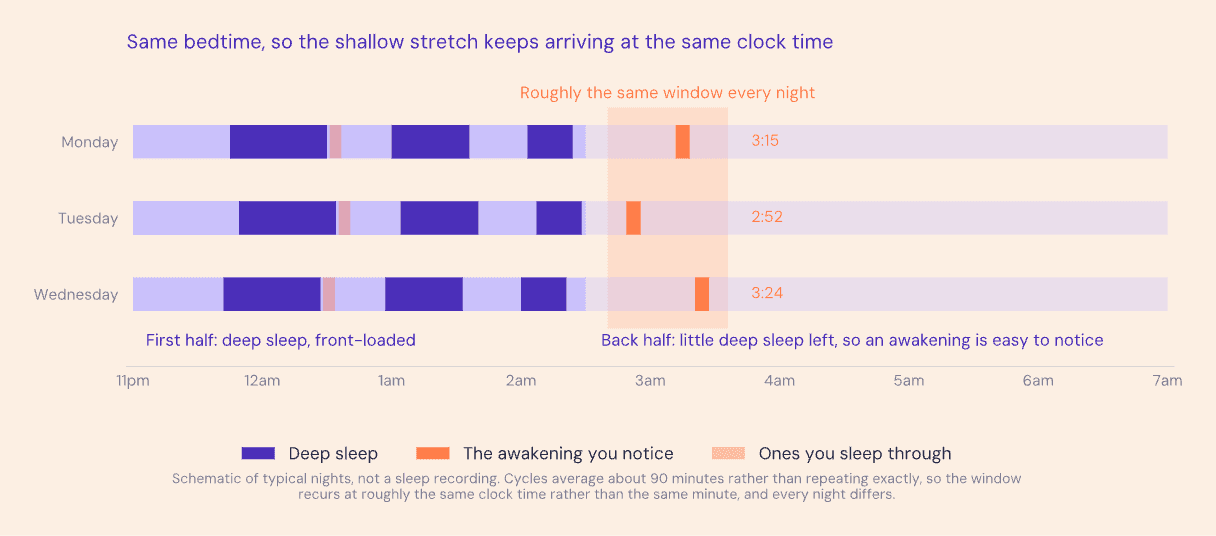
Then two things decide whether that stirring becomes an hour of staring: arousal levels and looking at the clock.
In insomnia, arousal is already running high. Compared with good sleepers, people with insomnia show signs of a nervous system that stays a little switched on, night and day. The evidence is clearest for cortical arousal and for a mind that will not stop working [5]. Either way, a brief awakening that a good sleeper would never remember is more likely to become an hour: you surface, the mind starts scanning, and the body behaves as though something needs solving right now.
The clock is what finishes it. Looking at the time turns a brief stirring into "I'm up." Clock-monitoring experiments found that watching the time raised worry and stretched out how long people took to fall asleep, including in people who usually sleep fine. In insomnia it also made them overestimate how long they had been lying there awake [6]. Those experiments measured the start of the night rather than 3am, so treat the middle-of-the-night version as the same move in a harder moment: it confirms you are awake, starts the arithmetic, and raises exactly the arousal you need to come down from. You are not being woken by the hour. You are being kept awake by what happens after you check it.
Does a Cortisol Spike Wake You at the Same Time Each Night?
Cortisol does rise overnight, and that fact is what the "3am cortisol dump" story is built on. In 20-minute cortisol profiling of 33 healthy adults, cortisol hit its lowest point around midnight, started climbing around 2am to 3am, and peaked around 8:30 in the morning [7]. That is the body getting ready for the day. It is a slow ramp, not a dump that yanks you out of sleep at a cursed hour.
Every one of those 33 adults had a measurable rhythm, and most people sleep straight through theirs. A normal overnight rise does not tell you that cortisol is what woke you, and it is not a sign of a broken adrenal system either.
The same goes for the organ-clock charts that map the liver to 1am–3am and the lungs to 3am–5am. Sleep medicine does not assign organs to clock hours. The same-time pattern has a more ordinary explanation: where you are in the night, plus what you do once you notice you are awake.
Waking at the same time most nights?
Rest is a program built on the principles of CBT-I that retrains the pattern, not the clock.
Is Waking at the Same Time Every Night a Sign of Insomnia?
Waking is not insomnia. Chronic insomnia means recurring trouble falling asleep, staying asleep, or getting back to sleep when you had a fair chance at it, generally at least three nights a week for at least three months, with days that pay for it [8]. That last part carries more weight than people expect. In that 2010 study, difficulty falling back asleep came with daytime repercussions in 77% of cases. Awakenings without that difficulty rarely did [1].
If you stir, turn over, and drop back off, that is a night. If the same hour has become a standing appointment, and you are tired the next day, that is the pattern worth changing.
A few wake-ups are medical rather than learned. See a doctor if you snore loudly or gasp, if your legs kick or crawl, if pain wakes you, if you are up to pee several times. The rest of this article is about the common, stress-and-habit kind.
Why Do You Wake Up Every Hour at Night?
That is a different pattern. Waking every hour is sleep that never stays down. Cycles do not run hourly, so this is not the shape of the night showing through. It is fragmentation, and the timing on its own cannot tell you the cause. Pain, medication, menopausal night sweats, a disrupted bedroom, and sleep disorders such as apnea all belong on the list, alongside the more common culprits below.
Common amplifiers:
Alcohol in the evening. It can make the first part of the night feel easy, then sleep turns lighter and more broken as your body clears it [9]. More on how alcohol affects sleep.
Caffeine still on board. An afternoon cup can still be active overnight, which lightens sleep and makes those brief awakenings easier to catch and hold. More on whether caffeine can make you wake up at night.
A racing mind. Unfinished worry treats the first stirring as a cue to start working.
A bedroom that is too warm. Rest's range is 65–68°F, and not above 70°F.
If every-hour waking is new, loud snoring or gasping is in the mix, or you never feel restored no matter how long you stay in bed, check this with your clinician.
What Makes Same-Time Night Waking Stick Around?
After enough nights of clock math and effort, the bed itself becomes a cue for being awake instead of for sleep [10]. That is why lying awake in bed feels worse the longer you stay put.
A few habits quietly rehearse the hour:
Checking the time. It confirms you are awake and starts the counting. Turn the clock away, or put it in another room.
Trying to force sleep. Effort is alerting. The harder you order yourself back under, the more awake you get. More on why trying to force sleep backfires.
Going to bed earlier to catch up. A longer window with the same amount of sleep in it just means more time awake in bed, which is the pairing you are trying to break.
Sleeping in or napping the next day. Sleep drive builds with every hour you are awake, and daytime sleep spends it early, so there is less left to carry you through tonight. More on whether napping causes insomnia.
None of this means you caused your insomnia on purpose. It means the bed and the small hours got paired with being awake, and the daytime catch-up kept the pairing in place.
What Helps If You Wake at the Same Time Every Night?
For the night you are already in: if you have been fully awake for what feels like 15 or 20 minutes and sleep is not coming, get out of bed. Estimate it rather than timing it, because the point is to leave the bed, not to give yourself another reason to look at the clock. Keep the lights low. Do something dull until you feel sleepy, then go back. That is stimulus control, a core piece of CBT-I (Cognitive Behavioral Therapy for Insomnia), and it keeps the bed from pairing with the frustration of being awake [10]. The full sequence, including what not to do, is in what to do at 3am when you can't get back to sleep.
For the pattern: CBT-I is the first-line treatment for chronic insomnia in adults, strongly recommended by the American Academy of Sleep Medicine [11]. It works by changing the behaviors and thoughts that keep the wake-ups running, including the clock-watching, the extra time in bed, and the next-day catch-up. Sleep hygiene on its own, a cooler room, a darker curtain, is a weak treatment for insomnia that has been going on for months [12].
Rest is a program built on the principles of CBT-I, plus circadian biology and neuroscience, together with world-class sleep experts from institutions like UCSF and Stanford. It coaches you through those behavior changes in short daily conversations, by text or by voice, adapting as your sleep changes rather than handing you a static plan. The night-waking number is the one to watch there: in Rest's 2026 outcomes study, 318 users who completed eight weeks cut their time awake in the middle of the night by 49%.
Frequently Asked Questions
Why do I wake up at the same time every night? Brief awakenings get more common in the second half of the night, once most of your deep sleep is behind you and REM periods are getting longer. If your bedtime is fairly regular, that stretch lands at roughly the same clock time. Checking the clock then makes a brief stirring far more likely to turn into an hour awake.
Why do I wake up every hour at night? That is fragmentation rather than one wake-up at a repeating hour, and the timing alone cannot tell you why. Alcohol, late caffeine, pain, medication, menopausal symptoms, a disrupted bedroom, and sleep disorders such as apnea are all on the list. If it is new, or you snore and gasp, see a doctor.
Is waking up at the same time every night a sign of insomnia? Not by itself. Chronic insomnia means the trouble getting back to sleep keeps recurring, generally at least three nights a week for three months or more, and your days pay for it. Brief awakenings that you sleep through or return from quickly are a normal part of the night.
Does a cortisol spike cause you to wake up at the same time each night? Cortisol does start rising in the early morning as part of the body clock, but that is a gradual ramp in healthy people, not a dump at a fixed minute. Most people sleep through it, and a normal rise does not tell you cortisol is what woke you.
Should I get out of bed if I wake at the same time every night? Yes, if you are clearly awake and getting frustrated. Go by how it feels rather than by the clock, at roughly the 15 or 20 minute mark. Leave the bedroom, keep the lights low, do something calm and dull, and go back only when you feel sleepy.
Rebuilding the Nights That Keep Repeating
If the same hour has been waiting for you for months, changing the clock will not change the night. Rest is built to unwind the loop around that hour: short daily conversations, the behavioral principles of CBT-I, and a plan that adapts to your actual nights. Start with Rest »
Disclaimer. This article is published for general information only. It is not medical advice or a diagnosis, and nothing here is a recommendation to take, avoid, or change any supplement or medication. Rest is not a substitute for professional medical care. Do not start, stop, or adjust a treatment, including a prescribed sleep medication, without talking to your clinician.
Citations
Ohayon, M. M., Krystal, A., Roehrs, T. A., Roth, T., & Vitiello, M. V. (2010). Using difficulty resuming sleep to define nocturnal awakenings. Sleep Medicine, 11(3), 236–241. https://doi.org/10.1016/j.sleep.2009.11.004 — 8,937 adults; 35.5% woke at least 3 nights per week; 15.2% of the sample had difficulty resuming sleep; daytime repercussions in 77% of those with difficulty resuming sleep.
Carskadon, M. A., & Dement, W. C. (2011). Normal human sleep: An overview. In M. H. Kryger, T. Roth, & W. C. Dement (Eds.), Principles and Practice of Sleep Medicine (5th ed.). Elsevier Saunders. — NREM–REM cycles average about 90–110 minutes, with the first cycle about 70–100 minutes and later cycles about 90–120; slow-wave sleep concentrates in the early cycles; stage 2 expands and REM episodes lengthen across the night.
Dijk, D. J., Duffy, J. F., & Czeisler, C. A. (2001). Age-related increase in awakenings: Impaired consolidation of nonREM sleep at all circadian phases. Sleep, 24(5), 565–577. https://doi.org/10.1093/sleep/24.5.565 — 482 sleep episodes under forced desynchrony in 11 young and 13 older healthy adults; pre-awakening sleep contained more REM sleep than overall sleep in both age groups (described by the authors as the gating of wakefulness by REM sleep); circadian phase modulated the duration of awakenings rather than their frequency.
Dijk, D. J., & Czeisler, C. A. (1995). Contribution of the circadian pacemaker and the sleep homeostat to sleep propensity, sleep structure, electroencephalographic slow waves, and sleep spindle activity in humans. Journal of Neuroscience, 15(5), 3526–3538. https://doi.org/10.1523/JNEUROSCI.15-05-03526.1995 — REM sleep peaks shortly after the core-body-temperature minimum; sleep-dependent REM increase plus that circadian peak produces high REM toward the end of a normal night.
Dressle, R. J., & Riemann, D. (2023). Hyperarousal in insomnia disorder: Current evidence and potential mechanisms. Journal of Sleep Research, 32(6), e13928. https://doi.org/10.1111/jsr.13928 — Review of hyperarousal in insomnia: evidence supports cortical arousal (high-frequency EEG activity) and cognitive-emotional hyperarousal; no conclusive evidence for autonomic measures such as heart rate and heart rate variability.
Tang, N. K. Y., Schmidt, D. A., & Harvey, A. G. (2007). Sleeping with the enemy: Clock monitoring in the maintenance of insomnia. Journal of Behavior Therapy and Experimental Psychiatry, 38(1), 40–55. https://doi.org/10.1016/j.jbtep.2005.07.004 — Clock monitoring increased pre-sleep worry and sleep-onset latency in good and poor sleepers; in insomnia, it also increased overestimation of time to fall asleep. Measured at sleep onset, not during middle-of-the-night awakenings.
Chan, S., & Debono, M. (2010). Replication of cortisol circadian rhythm: new advances in hydrocortisone replacement therapy. Therapeutic Advances in Endocrinology and Metabolism, 1(3), 129–138. https://doi.org/10.1177/2042018810380214 — 33 healthy adults, 20-minute cortisol profiling: nadir around midnight, rise around 02:00–03:00, peak around 08:30; all 33 individuals showed a significant circadian rhythm. Reports the authors' Debono et al. 2009 dataset.
American Academy of Sleep Medicine. (2023). International Classification of Sleep Disorders (3rd ed., text revision). Darien, IL: American Academy of Sleep Medicine. — Chronic insomnia disorder requires a sleep–wake complaint with associated daytime consequences, not explained purely by inadequate opportunity or circumstances for sleep, occurring at least three times per week and persisting for at least three months.
He, S., Hasler, B. P., & Chakravorty, S. (2019). Alcohol and sleep-related problems. Current Opinion in Psychology, 30, 117–122. https://doi.org/10.1016/j.copsyc.2019.03.007 — Alcohol disrupts sleep architecture, can trigger insomnia, and fragments later-night sleep.
Perlis, M. L., Smith, M. T., Benson-Jungquist, C., & Posner, D. A. (2005). Cognitive Behavioral Treatment of Insomnia: A Session-by-Session Guide. New York: Springer. https://doi.org/10.1007/0-387-29180-6 — Conditioned arousal and stimulus control; get out of bed once clearly awake and return only when sleepy.
Edinger, J. D., Arnedt, J. T., Bertisch, S. M., Carney, C. E., et al. (2021). Behavioral and psychological treatments for chronic insomnia disorder in adults: an American Academy of Sleep Medicine clinical practice guideline. Journal of Clinical Sleep Medicine, 17(2), 255–262. https://doi.org/10.5664/jcsm.8986 — CBT-I as first-line treatment for chronic insomnia in adults.
Irish, L. A., Kline, C. E., Gunn, H. E., Buysse, D. J., & Hall, M. H. (2015). The role of sleep hygiene in promoting public health: A review of empirical evidence. Sleep Medicine Reviews, 22, 23–36. https://doi.org/10.1016/j.smrv.2014.10.001 — Sleep hygiene advice alone is a weak treatment for insomnia.