
Study at a glance
Analytic cohort
318 users who completed 8 weeks
Design
Real-world, pre–post, week 1 vs week 8
Outcomes measured
Sleep efficiency, sleep onset latency, wake after sleep onset, total sleep time
Benchmarked against
Three published CBT-I programs (2017–2024)
Results at a glance · 318 users · 8 weeks
Sleep outcomes within the ranges reported for in-person, specialist-delivered CBT-I
Executive Summary
Rest is a consumer-grade AI-driven sleep program designed using the principles of cognitive behavioral therapy for insomnia (CBT-I), circadian biology, behavior change, and other disciplines to target better sleep.
In a real-world cohort of 318 users who completed 8 weeks of Rest, sleep efficiency rose from 75% to 88% (+13 percentage points), time needed to fall asleep fell by 52% (from 28 to 13 minutes), and time spent awake after sleep onset fell by 49% (from 56 to 29 minutes). Additionally, 73.3% of users reached the clinical benchmark of having a sleep efficiency of 85% or higher.
Rest users’ sleep improvements were on par with more costly and time-consuming behavioral interventions (e.g., fully digital CBT-I programs, CBT-I programs with human coaches or nurses).1–3
Key Terms

Introduction
Rest is an AI-driven digital program for people struggling with sleep. Rest includes an AI Coach that provides interactive support to help users manage their sleep habits and is accessible to anyone with a smartphone via traditional app stores.
Whereas standard CBT-I asks people to attend weekly sessions with a specialist or work alone through fixed digital modules, Rest’s AI Coach is on call 24/7, making a consumer-grade version of the sleep improvement program more accessible and interactive. These individualized, interactive conversations with the Rest AI Coach consistently provide sleep improvement guidance informed by CBT-I, behavior change, and circadian biology.
This document reports how Rest performs in the real world, and how those results compare to other digital and in-person CBT-I programs.
The analysis includes 318 users who enrolled between September 2025 and March 2026 and completed a full 8 weeks of Rest. Users complete sleep logs each night, and these allowed us to calculate standard sleep data outcomes as done across the CBT-I literature. These outcomes include sleep efficiency (SE), sleep onset latency (SOL), wake after sleep onset (WASO), and total sleep time (TST). We compared users’ first week of sleep log data to their final (eighth week) of sleep log data.
Rest’s 8-week sleep outcomes land within ranges reported for in-person, specialist-delivered CBT-I, and often exceed key sleep outcomes published in digital and coach-supported programs.
Outcomes
Changes in key sleep metrics across 318 users who completed 8 weeks of Rest.
Rest vs CBT-I Programs
Rest’s sleep outcomes can be compared with published results from other digital and human coach-supported CBT-I programs.1–3 Populations, designs, and follow-up windows differ across studies; however, all studies included individuals who were interested in improving their sleep.
Across these programs, Rest shows the largest reduction in SOL, an increase in SE on par with comparators, and a reduction in WASO in line with comparators, achieved over the shortest window and without human contact time.
Methods
Analyses included data collected between September 2025 and March 2026.
User Eligibility Criteria
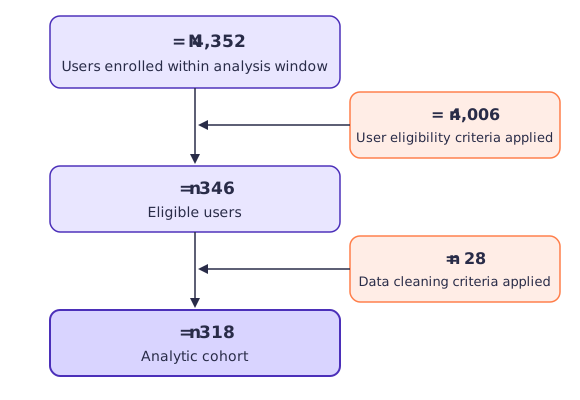
A user was eligible if they completed 8 weeks of Rest, defined as providing at least 6 of 7 sleep diaries (85%) at week 1 (“pre”) and week 8 (“post”).
Data Cleaning Criteria
We removed individual sleep log records using the following thresholds to minimize data loss while excluding impossible values and likely data entry errors. In total, record removal resulted in the exclusion of 28 users, each of whom had an average of 5.9 affected records (range from 1 to 20 cases per excluded user).
Summary of Analytic Cohort Identification
User Demographics
Outcome Metrics
We computed outcomes using standard calculation methods used in CBT-I clinical outcome research:
Total Sleep Time (TST)
Minutes between sleep onset and final awakening.
Time in Bed (TIB)
Minutes between when an individual gets into bed the first time and gets out of bed for the last time.
Sleep Efficiency (SE)
(TST / TIB) × 100.
Wake After Sleep Onset (WASO)
Minutes awake after first falling asleep and before final awakening.
Sleep Onset Latency (SOL)
Minutes between when an individual begins trying to fall asleep and sleep onset.
Calculation Method
For each user, we calculated “pre” values as the mean of sleep log entries completed during week 1, and “post” values as the mean of log entries completed during week 8. We calculated within-person pre-post changes as both absolute change scores. We summarized continuous variables using means (M) and standard deviations (SD), and categorical variables using counts and percentages. We conducted paired-samples t-tests and reported 95% confidence intervals for all effects. We defined statistical significance as p < .05. We conducted all statistical analyses using STATA Version 18 software.
Scope and Limitations of the Analysis
Limitations include, but are not limited to, a self-selected sample of users, lack of a control group, and completer (not intention-to-treat) analysis. We performed completer analyses because (1) Rest is commercially available and it is possible that users may simply be exploring the program and not intending to follow the program and an intention-to-treat analysis may therefore include users who did not actually have real intentions to follow the program, and (2) these initial analyses explore the effects of the Rest program for those who engage with it, and speak to whether the program can elicit change in sleep outcomes of interest in engaged users.
Commitment to Transparency & Next Steps
We are committed to transparent reporting and will publish updated analyses of the impact of Rest on sleep outcomes. We aim to perform clinical effectiveness trials in the future.

Conclusions
In just 8 weeks, Rest produced sleep improvements that fell within the range reported for in-person, specialist-delivered CBT-I — and it delivered these improvements using a platform that is less expensive, more scalable, and more personalized than fully digital CBT-I programs and CBT-I programs with human coaches or nurses. For individuals seeking help with their sleep, Rest may be the answer.
Better sleep.
Across 318 users who completed 8 weeks of Rest, 73.27% reached a Sleep Efficiency (SE) of 85% or higher, wake time after sleep onset (WASO) fell by 49%, and sleep onset latency (SOL) fell by 52% — these outcomes are on par or better than those of CBT-I delivered by fully digital CBT-I programs and CBT-I programs with human coaches or nurses.
And a better way to deliver it.
A full therapist-led CBT-I course can run in the range of $1,200–2,000 out of pocket, and waitlists for skilled CBT-I providers can be years long. Rest provides an expanded consumer-grade program designed using the general principles of CBT-I through its AI Coach, thus scaling without a human in the loop, and the core program is free to start. In contrast, coach-supported apps reintroduce the same human bottleneck and cost, and static self-guided modules do not adapt to the individual’s learning style. Rest is fully automated and deeply personalized, available 24/7 and delivering content in bite-sized daily interactions. Rest’s AI Coach continuously adapts to each user's needs using multiple data streams, including a users’ daily sleep log data and information users provide in conversations with the Rest AI Coach.
Initial outcomes reflect major sleep improvements despite the variability inherent in real-world data.
Outcomes reported here are from a self-selected, engaged user sample, not a randomized controlled trial. These results, therefore, reflect how Rest performs for people who actually engage with it.
What Is Rest?
Rest is a mobile app that delivers a program based on the principles of CBT-I — and expanded beyond them — through its personalized AI Coach. Instead of weekly appointments or a library of video modules to work through alone, users have short daily voice conversations: they talk, the AI coach listens and responds, all the while delivering sleep management content informed by general principles of CBT-I — time-in-bed restriction, stimulus control, cognitive restructuring, relaxation, and sleep hygiene — so learning the core skills takes just a few minutes of conversation a day.
Rest’s AI Coach gets to know each user over time, building a memory of their sleep history, patterns, and goals, and although it adapts the user’s Rest program experience as the user’s data accumulates, Rest maintains fidelity to proven sleep improvement techniques based on the general principles of CBT-I.
Rest always includes a daily sleep log to track progress. Week by week, Rest provides adaptive sleep windows that shift as a user’s sleep efficiency improves. The result is a structured, yet personalized program that runs on the user’s schedule.
What Rest Provides Each User
An evidence-based sleep improvement program

The complete set of five evidence-based components: time in bed restriction, stimulus control, cognitive restructuring, relaxation, and sleep hygiene — sequenced into a structured program, not a content library. *
Daily voice check-ins

Short spoken conversations with Rest’s AI Coach that teach, and listen: every check-in includes a rapid, tailored interview, so the AI Coach understands them a little better each day.
An adaptive sleep window
A recommended earliest bedtime and wake time, adjusted on a rolling basis as the user’s data accumulates and their sleep efficiency improves.
Adaptive memory

The AI Coach remembers everything, building a living map of each user across 20+ sleep factors, plus their history, preferences, and goals, so no conversation ever starts from zero.
A coaching engine built for behavior change

Rest’s AI Coach works methodically toward lasting habits, and every check-in ends with a short, concrete action list the user can put into practice immediately.
Wearable integration

Apple Watch and other wearable data can be set to auto-complete the nightly sleep log when biometric data are available, cutting daily logging friction to a quick morning verification.
Free to start

The free version of Rest includes top-shelf education designed using general principles of CBT-I, the sleep log, time-in-bed restriction calculations and algorithms, and relaxation and cognitive tools. We believe it is the most complete free offering for people looking for CBT-I-based consumer-grade solutions. The paid version unlocks the Rest AI Coach, complete with voice check-ins, adaptive memory, and the Rest coaching engine.
* Disclaimer: Rest is intended for general wellness, informational, or educational purposes only. Rest is a tool for sleep improvement and is not intended to diagnose, treat, cure, or prevent any disease or health condition, and is not intended for any medical use. It does not replace care or CBT by your healthcare provider or any other treatments you may be using.
Who Builds Rest
The Rest Team
Rest is built by a 20+ person team with expertise in health technology, data science, and AI. The team has a track record of building consumer products at scale — collectively, 100+ million downloads across prior mobile products.
Scientific Advisors



References
1. Ulmer CS, Voils CI, Jeffreys AS, et al. Nurse-supported self-directed cognitive behavioral therapy for insomnia: A randomized clinical trial. JAMA Intern Med. 2024;184(11):1356-1364.
2. Ritterband LM, Thorndike FP, Ingersoll KS, et al. Effect of a web-based cognitive behavior therapy for insomnia intervention with 1-year follow-up: A randomized clinical trial. JAMA Psychiatry. 2017;74(1):68-75. doi:10.1001/jamapsychiatry.2016.3249
3. Gorovoy SB, Campbell RL, Fox RS, Grandner MA. App-supported sleep coaching: implications for sleep duration and sleep quality. Front Sleep. 2023;2. doi:10.3389/frsle.2023.1156844
4. Morin CM, Buysse DJ. Management of Insomnia. N Engl J Med. 2024;391(3):247-258. doi:10.1056/NEJMcp2305655
5. Qaseem A, Kansagara D, Forciea MA, Cooke M, Denberg TD, for the Clinical Guidelines Committee of the American College of Physicians. Management of Chronic Insomnia Disorder in Adults: A Clinical Practice Guideline From the American College of Physicians. Ann Intern Med. 2016;165(2):125-133. doi:10.7326/M15-2175
6. Edinger JD, Arnedt JT, Bertisch SM, et al. Behavioral and psychological treatments for chronic insomnia disorder in adults: An American Academy of Sleep Medicine clinical practice guideline. J Clin Sleep Med JCSM Off Publ Am Acad Sleep Med. 2021;17(2):255-262. doi:10.5664/jcsm.8986
7. Riemann D, Baglioni C, Bassetti C, et al. European guideline for the diagnosis and treatment of insomnia. J Sleep Res. 2017;26(6):675-700. doi:10.1111/jsr.12594
8. American Psychiatric Association. Diagnostic and Statistical Manual of Mental Disorders (DSM-5®). American Psychiatric Association; 2013.
9. Darden M, Espie CA, Carl JR, Henry AL, Kanady JC, Krystal AD, Miller CB. Cost-effectiveness of digital cognitive behavioral therapy (Sleepio) for insomnia: a Markov simulation model in the United States. Sleep. 2021;44(4):zsaa223. doi:10.1093/sleep/zsaa223
Cost note: the $1,200–2,000 out-of-pocket estimate assumes a standard six-to-eight-session CBT-I course at typical US individual-psychotherapy rates — Medicare reimburses roughly $100–160 per session (CPT 90834/90837; 2025 CMS Physician Fee Schedule), with private-pay rates commonly $150–250+ per session. See reference 9 for a peer-reviewed cost-effectiveness analysis of fully automated digital CBT for insomnia (Darden et al., 2021).
PDF · 14 pages · 2026
Real-World Effectiveness of Rest: An AI-Driven Sleep Improvement Program Based on the Principles of Cognitive Behavioral Therapy for Insomnia (CBT-I)
8-week sleep outcomes from 318 Rest users.
© 2026 Rest
Download