
Scientifically Reviewed by
Dr. Elaine Blank, PhD
PhD in clinical psychology from the University of Arizona, Clinical internship at the University of Maryland,
Postdoctoral work at the Stanford University School of Medicine
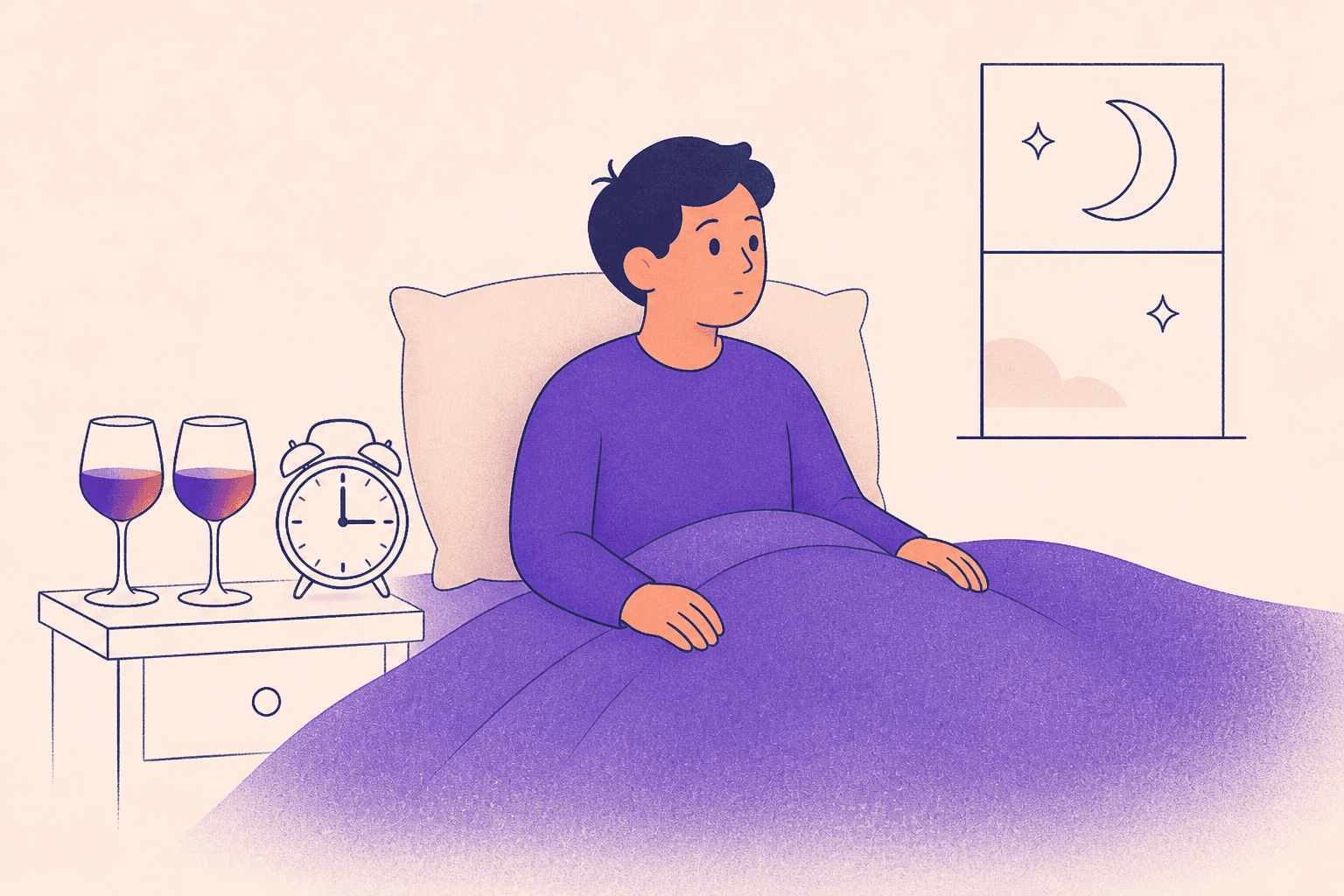
The wine works to make you sleepy, and that's the problem. You drift off without effort, then you're awake at 3am with no idea what happened. The part of the night alcohol ruins is the part you never agreed to trade away.
Yes, alcohol affects sleep, and it takes less than most people assume. Rapid eye movement (REM) sleep starts taking a measurable hit at around two standard drinks [1]. And the one effect people actually count on, falling asleep faster, only shows up reliably at roughly five drinks [1]. For most people, a nightcap isn't even buying the thing it's supposed to.
What Does Alcohol Actually Do to Your Sleep?
Alcohol is a sedative, and that effect lasts only while it's still in your system. Early in the night it can deepen sleep and shorten the time it takes to drop off. As your body metabolizes it, the sedative effect fades and sleep turns lighter and more broken [2]. A couple of hours later, right when you wanted to stay under, alertness can rebound as alcohol in blood falls.
That timing is why drinking feels like it helped. You notice the drowsy part. The fragmentation lands while you're already out, so you don't clock it until later in the night.
Alcohol doesn't only fragment the night you drink. A 2019 review also links it to circadian rhythm abnormalities, the body clock that times sleep and waking, and to shorter sleep overall [3]. That's a separate problem from the drowsy-then-rebound pattern.
How Much Alcohol Is Too Much for Sleep?
Less than the amount most people consider moderate. In the US, one standard drink is 14 grams of pure alcohol: about 5 oz of 12% wine, 12 oz of 5% beer, or 1.5 oz of 40% spirits. A poured glass of wine is often more than one [4].
A 2025 systematic review and meta-analysis of 27 studies found that "disruptions to REM sleep occurred following consumption of a low dose of alcohol (≤0.50 g∙kg-1 or approximately two standard drinks) and progressively worsened with increasing doses of alcohol" [1].
Two drinks. Not five, not a bottle. And the same analysis found the reduction in time-to-fall-asleep only appeared at high doses of about five standard drinks, which means the trade almost everyone thinks they're making, a little worse quality for a lot faster onset, isn't the trade on offer. At two drinks you get the sleep cost without the sedative benefit. You might feel more drowsy with 1-2 drinks, but you’re unlikely to fall asleep significantly faster.
Still using a drink to get to sleep?
Rest is a program built on the principles of CBT-I that rebuilds your sleep without a nightcap.
Does Alcohol Cause You to Wake Up at Night?
Probably, but here the honest answer is less tidy than most articles admit. Alcohol can disrupt the later part of the night [2], although the latest meta-analysis found uncertainty about its effect on waking after sleep onset specifically [1]. It likely contributes to lighter, less restful sleep, but not always to full awakenings.
So if you wake at 3am after drinking, alcohol is a reasonable suspect and a poor certainty. What is clear is that it won't fix it. When researchers followed 150 adults through 60 days of ordinary life, they concluded that "alcohol does not systematically improve sleep quality or duration in real life" [5]. If you're already awake, skip the glass: does alcohol help you get back to sleep covers why a nightcap backfires, and what to do at 3am when you can't get back to sleep is the actual routine.
How Long Before Bed Should You Stop Drinking?
Rest uses four hours as a conservative program rule, not a research-established cutoff. The 2025 review set out to identify the influence of both dose and timing, and it produced clear dose findings and no publishable timing threshold [1]. Four hours does not guarantee the alcohol has cleared, especially after several drinks. Metabolism varies from person to person [4]. Drinking less is more important than treating four hours as a guarantee.
Can Alcohol Cause Insomnia?
It can contribute to it. A 2019 review describes alcohol disrupting sleep "through multiple mechanisms, such as disrupting electrophysiologic sleep architecture, triggering insomnia, and contributing to abnormalities of circadian rhythms and short sleep duration" [3]. The same review notes alcohol increases breathing-related events such as snoring and oxygen desaturation, particularly in people who already have those problems [3].
The loop is the dangerous part. You sleep badly, so you have a drink to get to sleep, which makes the later hours worse, so you sleep badly. If you've come to rely on a drink to fall asleep at all, that's worth raising with your doctor rather than solving alone. There's more on both substances in how coffee and alcohol affect your sleep.
What Works Instead Of Using Alcohol to Sleep?
Cognitive Behavioral Therapy for Insomnia (CBT-I) is strongly recommended for chronic insomnia in adults by the American Academy of Sleep Medicine [6]. The American College of Physicians recommends it as the initial treatment, ahead of medication [7]. It works by changing the behaviors and thoughts that keep the problem running, which is why the results outlast the intervention in a way a drink never does.
Rest is a program built on the principles of CBT-I, plus circadian biology and neuroscience, together with world-class sleep experts from institutions like UCSF and Stanford. It coaches you through the behavior changes in short daily conversations, by text or by voice, adapting as your sleep changes rather than handing you a static plan. It has over 2,000 five-star App Store ratings, and is backed by Y Combinator and Floodgate. The results are published too: in Rest's real-world outcomes data, 318 users who completed eight weeks cut their time awake at night by 49% and went from 75% to 88% sleep efficiency.
Frequently Asked Questions
Does one glass of wine affect sleep? It can. A 2025 meta-analysis found REM sleep disruption beginning at around two standard drinks, so one US standard drink sits under that measured threshold. A poured glass of wine is often more than 5 oz, so it may already be more than one [4]. The effect grows with the amount consumed.
Why do I wake up at 3am after drinking alcohol? Alcohol can make the early part of the night feel easy, then as your body clears it the sedative effect fades and sleep becomes lighter and more broken. That's when waking tends to happen.
Does alcohol reduce REM sleep? Yes. Alcohol both delays the onset of rapid eye movement (REM) sleep and reduces how much of it you get, with the effect starting at low doses of about two standard drinks and worsening as the dose increases [1].
How long before bed should I stop drinking alcohol? Rest uses four hours as a conservative program rule, not a research-established cutoff. Drinking less is more important than treating four hours as a guarantee.
Rebuilding Sleep Without the Drink
If your sleep has been off for months and a drink has become part of how you get through the night, that pattern is what Rest is built to unwind. Short daily conversations, the behavioral principles of CBT-I, and a plan that adapts to your actual nights. Start with Rest »
Citations
Gardiner, C., Weakley, J., Burke, L. M., Roach, G. D., Sargent, C., Maniar, N., Huynh, M., Miller, D. J., Townshend, A., & Halson, S. L. (2025). The effect of alcohol on subsequent sleep in healthy adults: A systematic review and meta-analysis. Sleep Medicine Reviews, 80, 102030. https://doi.org/10.1016/j.smrv.2024.102030 — "disruptions to REM sleep occurred following consumption of a low dose of alcohol (≤0.50 g∙kg-1 or approximately two standard drinks) and progressively worsened with increasing doses of alcohol."
Ebrahim, I. O., Shapiro, C. M., Williams, A. J., & Fenwick, P. B. (2013). Alcohol and sleep I: effects on normal sleep. Alcoholism: Clinical and Experimental Research, 37(4), 539–549. https://doi.org/10.1111/acer.12006 — "At all dosages, alcohol causes a reduction in sleep onset latency, a more consolidated first half sleep and an increase in sleep disruption in the second half of sleep."
He, S., Hasler, B. P., & Chakravorty, S. (2019). Alcohol and sleep-related problems. Current Opinion in Psychology, 30, 117–122. https://doi.org/10.1016/j.copsyc.2019.03.007 — "alcohol disrupts sleep through multiple mechanisms, such as disrupting electrophysiologic sleep architecture, triggering insomnia, and contributing to abnormalities of circadian rhythms and short sleep duration."
National Institute on Alcohol Abuse and Alcoholism. What is a standard drink? https://www.niaaa.nih.gov/alcohols-effects-health/what-standard-drink — one US standard drink is 14 grams (about 0.6 fl oz) of pure alcohol, equal to 5 oz of 12% wine; customary servings may be larger. Metabolism: The basics: defining how much alcohol is too much. https://www.niaaa.nih.gov/health-professionals-communities/core-resource-on-alcohol/basics-defining-how-much-alcohol-too-much — the rate of alcohol metabolism "varies widely among individuals."
Lydon-Staley, D. M., Ram, N., Conroy, D. E., Pincus, A. L., Geier, C. F., & Maggs, J. L. (2016). The within-person association between alcohol use and sleep duration and quality in situ: An experience sampling study. Addictive Behaviors, 61, 68–73. https://doi.org/10.1016/j.addbeh.2016.05.018 — "alcohol does not systematically improve sleep quality or duration in real life."
Edinger, J. D., Arnedt, J. T., Bertisch, S. M., Carney, C. E., et al. (2021). Behavioral and psychological treatments for chronic insomnia disorder in adults: an American Academy of Sleep Medicine clinical practice guideline. Journal of Clinical Sleep Medicine, 17(2), 255–262. https://doi.org/10.5664/jcsm.8986 — strong recommendation for multicomponent CBT-I for chronic insomnia in adults.
Qaseem, A., Kansagara, D., Forciea, M. A., Cooke, M., & Denberg, T. D., for the Clinical Guidelines Committee of the American College of Physicians. (2016). Management of chronic insomnia disorder in adults: A clinical practice guideline from the American College of Physicians. Annals of Internal Medicine, 165(2), 125–133. https://doi.org/10.7326/M15-2175 — ACP recommends CBT-I as the initial treatment for chronic insomnia disorder in adults.