

Scientifically Reviewed by
Dr. Elaine Blank, PhD
PhD in clinical psychology from the University of Arizona, Clinical internship at the University of Maryland,
Postdoctoral work at the Stanford University School of Medicine
You slept badly, so at 2pm the couch looks like the only decent thing you'll do for yourself all day. An hour later you feel human again. Then you're awake at midnight, running the same night over.
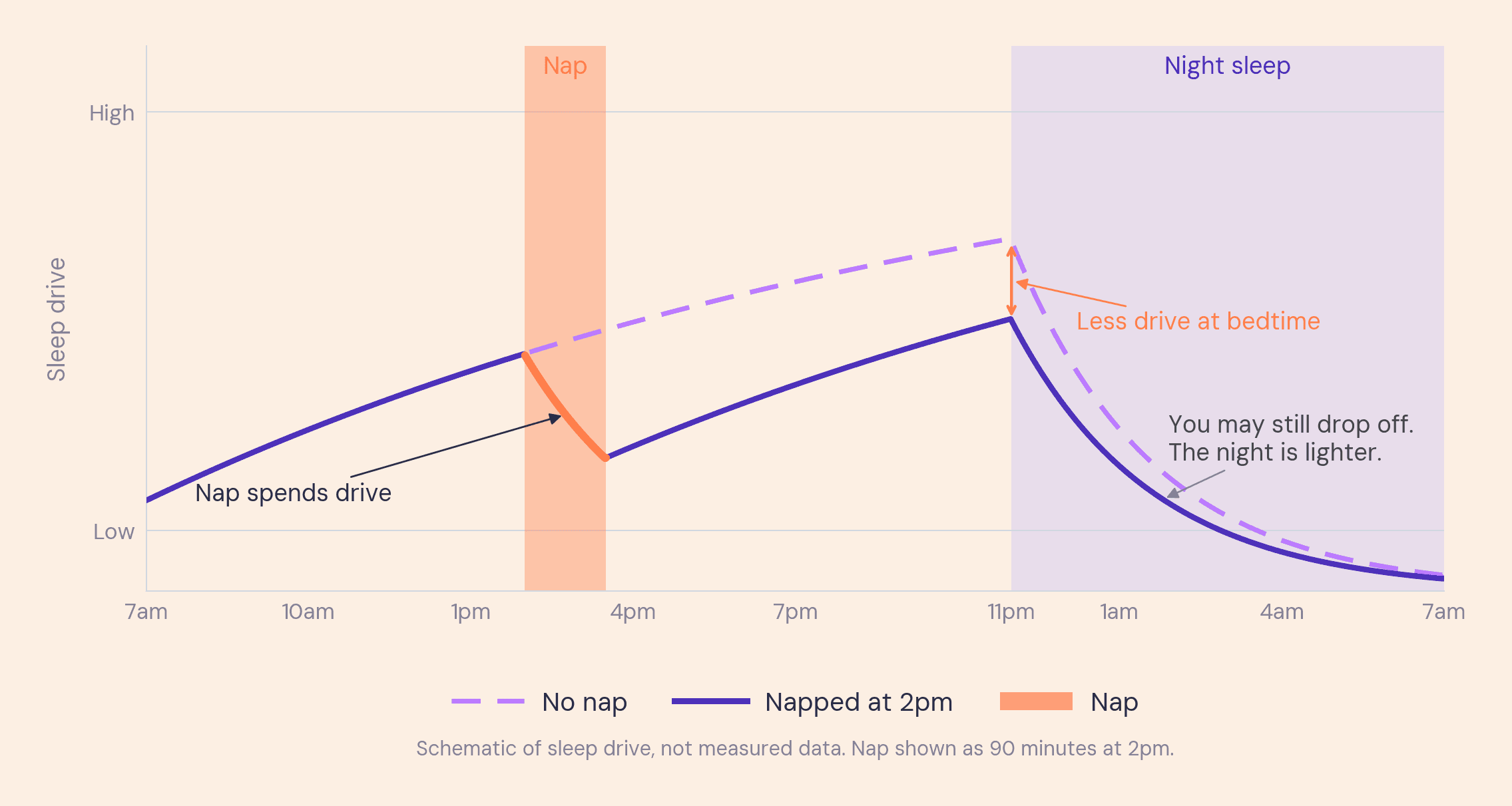
Does napping cause insomnia? Usually not by itself. If you already have insomnia, napping can keep it going. A nap spends the sleep drive your body has been building since morning, so you get to bedtime with less pressure to sleep [1, 2]. The slump that sent you to the couch is often your body clock, not proof last night ruined you, though a bad night can make that dip stronger [3]. Nap through it, and you've spent the tiredness that was supposed to help you tonight.
Why Does Napping Make Insomnia Worse?
Sleep drive is the pressure that builds the longer you've been awake. Nighttime sleep discharges it. Any sleep during the day spends some of that pressure, which is why a nap can leave you dropping off fine and then sleeping lighter, with more broken stretches, once the lights are out [1, 2].
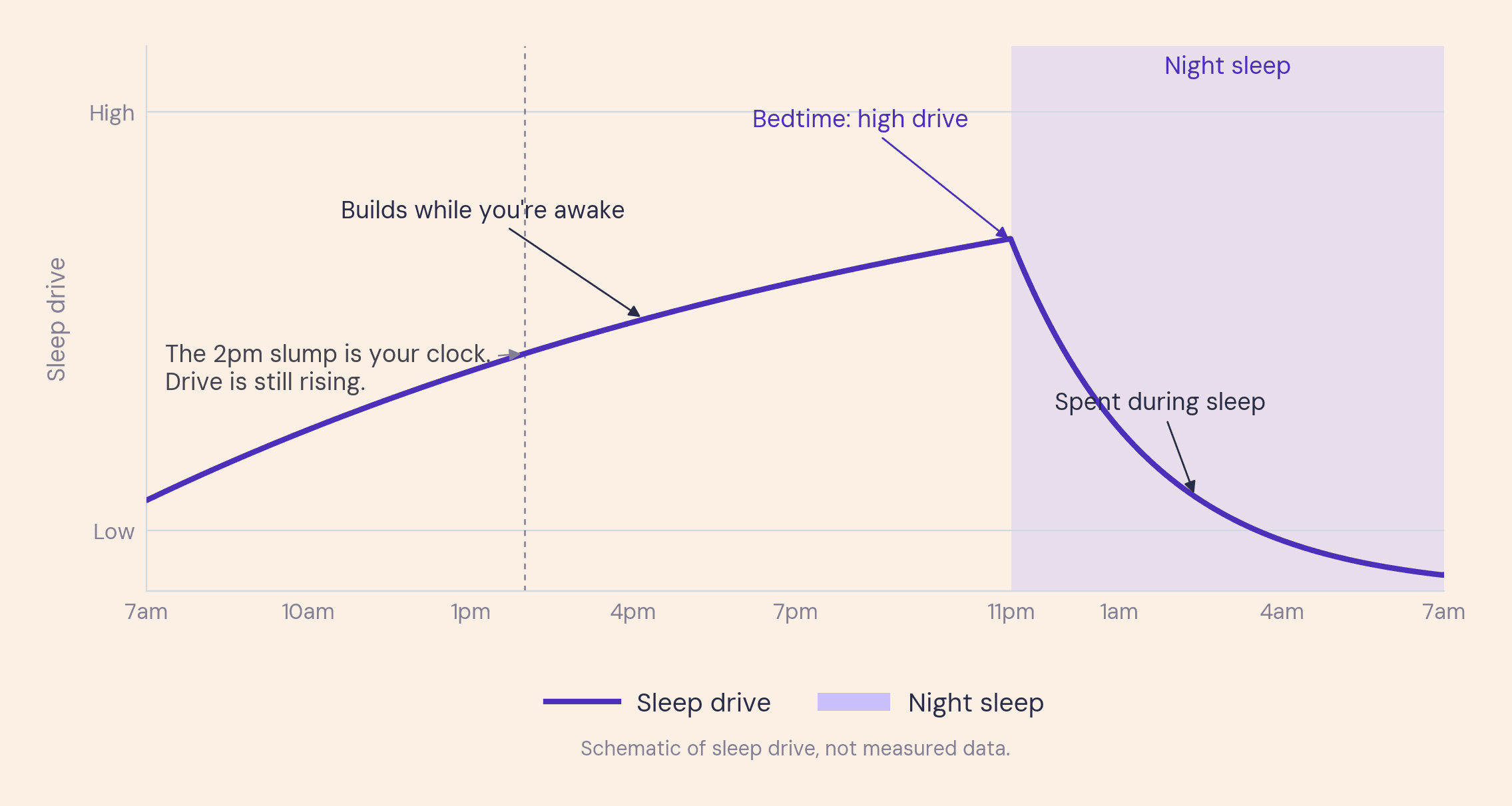
A nap will not usually give a good sleeper chronic insomnia. In people who sleep fine, studies on whether naps wreck the next night are mixed, and brief or early naps do not consistently disrupt nighttime sleep [4, 5]. The trap is using one to recover from nights that are already off. That afternoon catch-up feels like self-care. For insomnia, it takes the leftover tiredness from last night, the part that was supposed to help you sleep tonight, and spends it at 2pm.
In Cognitive Behavioral Therapy for Insomnia (CBT-I), any daytime sleep still counts as a nap: ten minutes on the couch, a doze at your desk, a planned hour in bed [2]. That is a protocol rule, not a claim that a 10-minute doze wrecks the night the same way a 90-minute one does. Duration and timing do change the overnight effect in people without insomnia [4, 5]. If your nights are already broken, the instruction is still to skip it.
Is The 2pm Slump A Sign You Slept Badly?
Not necessarily. A biological dip in alertness commonly shows up in the early afternoon, roughly 1pm to 4pm. Researchers still call it the post-lunch dip, but it can appear even with no lunch and no sense of the time [3]. It does not hit every person, or every measure of alertness, and a short night can make it stronger. It is not, by itself, proof that last night failed.
That dip can be real sleepiness, not just fog. For insomnia, the default is still not to nap through it. You feel it, you treat it as evidence you need to catch up, and the couch wins. Having a coffee can also make nighttime sleep harder, because its alerting effects can last for hours [6]. The dip often passes on its own. Standing up, getting a few minutes of daylight, or a glass of water will usually carry you through it without spending the sleep drive you need for later.
Late naps cost extra. An early-evening nap, close to the night you are trying to protect, has been shown to make that night slower to start and lighter once it does, because the pressure has already been spent [7]. CBT-I's rule is still no napping, not "no napping after 4pm." The clock makes the offer in the afternoon. Evening is when it costs you most.
Still napping to get through the day?
Rest is a program built on the principles of CBT-I that rebuilds sleep drive instead of spending it at 2pm.
What Works If The Nights Have Been Off For Months?
Skipping the nap clears the path. It is not the whole path. Sleep hygiene on its own is a weak treatment for insomnia that has been going on for a long time [4]. If you have been sleeping badly for months, the pattern is bigger than one afternoon on the couch. The same is true of the 3am wake-ups a nap does not prevent: what to do at 3am when you can't get back to sleep.
CBT-I is the first-line treatment for chronic insomnia in adults. The American Academy of Sleep Medicine strongly recommends it [9]. The American College of Physicians recommends it as the initial treatment, with medication considered afterward if CBT-I alone is unsuccessful [10]. It works by changing the behaviors and thoughts that keep the problem running, including the daytime sleep that spends tonight's drive.
Rest is a program built on the principles of CBT-I, plus circadian biology and neuroscience, together with world-class sleep experts from institutions like UCSF and Stanford. It coaches you through the behavior changes in short daily conversations, by text or by voice, adapting as your sleep changes rather than handing you a static plan. It has over 2,000 five-star App Store ratings, and is backed by Y Combinator and Floodgate. Among 318 users who completed eight weeks in Rest's 2026 outcomes study, sleep efficiency rose from 75% to 88%, time to fall asleep fell by 52% and time awake at night by 49%. iOS, subscription.
Should You Nap If You Have Insomnia?
No, if you are trying to rebuild healthy sleep patterns. If your nights are already broken, skip the nap so last night's lost sleep can help you build more sleep drive [2]. That's what Rest will ask of you in the program.
If you are sleepy enough that driving, or anything else unsafe, would be a bad idea, do not start it and do not keep going. Pull over or stop somewhere safe and rest. A brief nap can lift alertness for a short stretch. Resume only when you are fully alert; a nap is not proof you are safe to drive [8].
At home, Rest's exception is narrower: if you were truly sleepy, eyes closing, and you needed that safety rest, set a timer for 25 minutes and take it in your sleep bed. That in-bed rule is about keeping the bed tied to sleep, not about driving. Do not treat the afternoon slump as a reason to nap on the couch.
If you are sick, Rest's program allows naps for now, still in bed. Once you are nearly better, go back to the no-nap rule.
Frequently Asked Questions
Does napping cause insomnia? Usually not by itself. If you already struggle with insomnia, napping can keep it going by spending the sleep drive you need at night. A nap will not usually start chronic insomnia in someone who sleeps well.
Is a 20 minute power nap bad if you have insomnia? Rest's default is to skip it. Brief, early naps do not consistently disrupt nighttime sleep in people without insomnia. If your nights are already broken, Rest still counts a short nap as a nap, because it spends some of the pressure you need at bedtime. The 25-minute in-bed exception is for safety rest at home, not a daily power nap.
Why am I sleepy at 2pm even after a full night? A mid-afternoon dip in alertness is built into the body clock for many people. It can show up even without lunch, it does not hit everyone, and a short night can make it stronger. It is not, by itself, proof that last night failed.
Is it OK to nap after a bad night of insomnia? No, if you are trying to rebuild it. Last night's lost sleep is the pressure that helps you tonight. Napping spends that pressure in the afternoon, which is how one bad night turns into a stretch of them.
When is the worst time to nap for insomnia? Late afternoon and evening, close to bedtime, because the sleep drive you still had gets spent right before you need it. For insomnia, Rest's rule is still no napping at any hour, with a brief at-home safety exception.
Rebuilding Sleep Without The Afternoon Nap
If your sleep has been off for months and the 2pm couch has become how you get through the day, that pattern is what Rest is built to unwind. Short daily conversations, the behavioral principles of CBT-I, and a plan that adapts to your actual nights. Start with Rest »
Citations
Borbély, A. A., Daan, S., Wirz-Justice, A., & Deboer, T. (2016). The two-process model of sleep regulation: A reappraisal. Journal of Sleep Research, 25(2), 131–143. https://doi.org/10.1111/jsr.12371 — sleep drive (Process S) builds during wake and is discharged during sleep.
Perlis, M. L., Smith, M. T., Benson-Jungquist, C., & Posner, D. A. (2005). Cognitive Behavioral Treatment of Insomnia: A Session-by-Session Guide. New York: Springer. https://doi.org/10.1007/0-387-29180-6 — stimulus control includes not napping, so the prior night's lost sleep can help you fall asleep the next night.
Monk, T. H. (2005). The post-lunch dip in performance. Clinics in Sports Medicine, 24(2), e15–e23. https://doi.org/10.1016/j.csm.2004.12.002 — a mid-afternoon dip can occur with no lunch and no knowledge of the time of day; it does not appear in every person or every measure, and it is linked to increased sleep propensity.
Irish, L. A., Kline, C. E., Gunn, H. E., Buysse, D. J., & Hall, M. H. (2015). The role of sleep hygiene in promoting public health: A review of empirical evidence. Sleep Medicine Reviews, 22, 23–36. https://doi.org/10.1016/j.smrv.2014.10.001 — in nonclinical samples, most studies found little effect of daytime naps on the following night, including one comparison of naps shorter vs longer than 20 minutes; sleep hygiene advice alone is a weak treatment for insomnia.
Milner, C. E., & Cote, K. A. (2009). Benefits of napping in healthy adults: Impact of nap length, time of day, age, and experience with napping. Journal of Sleep Research, 18(2), 272–281. https://doi.org/10.1111/j.1365-2869.2008.00718.x — in healthy adults, nap effects vary by length, timing, age, and napping habit; short early naps are not equivalent to long or late ones.
Clark, I., & Landolt, H. P. (2017). Coffee, caffeine, and sleep: A systematic review of epidemiological studies and randomized controlled trials. Sleep Medicine Reviews, 31, 70–78. https://doi.org/10.1016/j.smrv.2016.01.006 — caffeine's alerting effects can last for hours and impair subsequent sleep.
Werth, E., Dijk, D. J., Achermann, P., & Borbély, A. A. (1996). Dynamics of the sleep EEG after an early evening nap: experimental data and simulations. American Journal of Physiology, 271(3), R501–R510. https://doi.org/10.1152/ajpregu.1996.271.3.R501 — after an evening nap, the following night had a longer time to fall asleep and less deep-sleep EEG activity.
National Highway Traffic Safety Administration. Drowsy Driving: Avoid Falling Asleep Behind the Wheel. https://www.nhtsa.gov/risky-driving/drowsy-driving (accessed August 2026) — if you start to get sleepy while driving, stop in a safe place; a short nap can raise alertness only for a short time.
Edinger, J. D., Arnedt, J. T., Bertisch, S. M., Carney, C. E., et al. (2021). Behavioral and psychological treatments for chronic insomnia disorder in adults: an American Academy of Sleep Medicine clinical practice guideline. Journal of Clinical Sleep Medicine, 17(2), 255–262. https://doi.org/10.5664/jcsm.8986 — AASM strongly recommends multicomponent CBT-I for chronic insomnia in adults.
Qaseem, A., Kansagara, D., Forciea, M. A., Cooke, M., & Denberg, T. D. (2016). Management of chronic insomnia disorder in adults: A clinical practice guideline from the American College of Physicians. Annals of Internal Medicine, 165(2), 125–133. https://doi.org/10.7326/M15-2175 — CBT-I as the initial treatment for chronic insomnia in adults; consider adding medication if CBT-I alone is unsuccessful.