

Scientifically Reviewed by
Dr. Elaine Blank, PhD
PhD in clinical psychology from the University of Arizona, Clinical internship at the University of Maryland,
Postdoctoral work at the Stanford University School of Medicine
Ask a behavioral sleep specialist how to fall asleep fast and the answer sounds like a joke: Get out of bed.
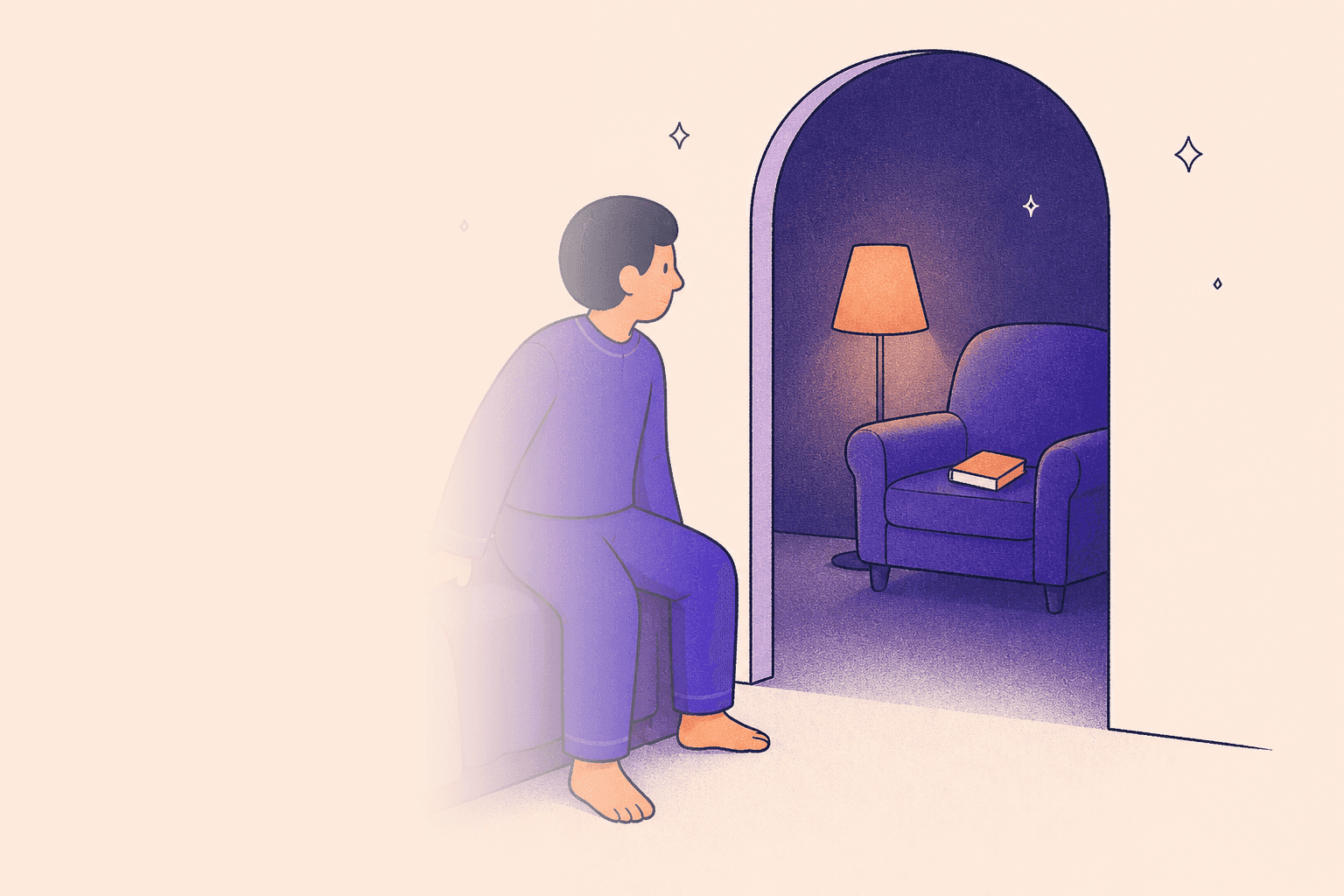
They mean it literally, and it is the most useful thing you can do. The moment you notice you are fully awake and starting to get annoyed, go, without checking the clock first. Leave the bedroom if you can. Keep the lights as low as you can stand and do something quiet and chill, a familiar paper book or audio with the screen off. Go back only when you actually feel sleepy, not when you decide you have waited long enough.
The reason to leave is what happens if you stay. Hours spent lying there working at it teach your body that bed is where you are awake and trying. String enough of those nights together and the bed stops being where sleep happens. That is how one rough night becomes a run of them, and why trying harder makes it worse instead of better.
If that is already the pattern, most nights, for months, then tonight is not really the problem, and there is an established answer for what is. Cognitive Behavioral Therapy for Insomnia (CBT-I) is the research-based first-line treatment for chronic insomnia [1]. Its behavioral core is a fixed wake time, no naps, and matching your time in bed to the sleep you are actually getting. The sleep-hygiene checklist the internet leads with is not a treatment on its own [1].
Why Trying Harder Makes It Harder to Fall Asleep
Sleep gets further away the more you chase it. Effort switches on arousal, and arousal keeps you from sleeping. When a person is suffering from insomnia, the body often stays in that alert state around the clock, not only at night. Heart rate sits a little higher, muscles stay a little tighter, and the mind keeps scanning. Clinicians call that hyperarousal [2]. So the moment you are trying to fall asleep and you notice you are still awake, the alertness spikes, and a delay that should have lasted a minute stretches into an hour of staring at the ceiling.
Worse, every frustrated hour spent in bed trains your brain the wrong way. The bed stops being a cue for sleep and becomes a cue for being awake. That connection is called conditioned arousal, and it is why lying awake in bed feels worse the longer you stay put [3]. Willing yourself to drop off feeds both of those loops at once.
This is also why "just relax" is useless advice. Relaxation is a real skill that needs to be learned and trained. It is not something you can order yourself to do while you watch the minutes go by.
How to Fall Asleep Fast Tonight
Leaving the bed is not folk advice. It is the central instruction of stimulus control, a set of rules designed to retrain the bed as a cue for sleep [3]. The American Academy of Sleep Medicine (AASM) suggests it as a treatment even on its own, and it is a standard piece of full CBT-I [1].
The part people get wrong is the timing. You do not need a stopwatch, and watching the clock is part of the problem. The signal is frustration: your mind is racing, you are getting annoyed, or you catch yourself forcing it. That is usually around 15 to 20 minutes [3]. Here is each step, and the detail that decides whether it works:
Get out of bed. Sitting up, standing and walking are all awake signals, which is exactly the point. You are interrupting the pairing between bed and wakefulness.
Keep the lights low. Overhead lights are the ones to avoid. Ordinary room lighting in the hours before bed delays the release of melatonin, the hormone that marks nighttime [4].
Do something quiet and dull. A simple body scan counts too. What matters is skipping anything that makes you more alert: messages, news, a show, a snack you will look forward to tomorrow.
Go back only when you feel sleepy, not because the clock moved. Sleepy is the pull of actual sleep, heavy eyelids, nodding. Tired-but-wired is not that. If you wake again later, run the same steps.
If a racing mind is what is keeping you up, wrestling the thoughts in bed usually feeds them. Get up first, then give the thoughts somewhere else to go: there are cognitive strategies for racing thoughts at bedtime that beat arguing with yourself in the dark.
This sequence can get you through tonight. If you have been taking a long time to fall asleep for weeks or months, it is also the start of retraining, not a one-night hack. Lasting change comes from running the same rules as a program, not from finding a trick that finally knocks you out.
One caveat: this is about the common, habit-and-arousal kind of delay, not insomnia driven by sleep apnea, restless legs, an overactive thyroid, or chronic pain. Loud snoring, waking up gasping for air, or feeling exhausted even after a full night in bed can point to a separate medical problem. Those symptoms should be evaluated by a doctor.
Still lying there trying to force it?
Rest is a program built on the principles of CBT-I. Short daily coaching, by text or voice, that rebuilds sleep instead of chasing a trick.
Why Sleep Hygiene Lists Don't End Insomnia
Almost every "fall asleep faster" article is a checklist: cooler room, no screens, herbal tea, magnesium, a wind-down routine. Some of those habits are worth doing. None of them, on its own, treats insomnia that has already lasted months.
The AASM weighed the evidence and suggests that clinicians not use sleep hygiene as a single-component therapy for chronic insomnia in adults [1]. A separate review of the public-health advice found the same thing. Sleep-hygiene education on its own is a weak treatment once insomnia has been going on for a long time [5].
That is the information most pages skip. The list is not empty, and it is not useless: these habits clear obstacles to sleep: a hot room, a late coffee, a nightcap. They are just aimed at the wrong layer. What they do not do is rebuild sleep drive or undo the pairing of bed with being awake that keeps chronic insomnia going.
These are the habits Rest actually coaches, as support rather than as the whole answer. The specific numbers are the program's own rules, picked to be easy to follow, not thresholds from a guideline:
Caffeine cutoff by 11am. Its half-life is about 4 to 6 hours, so a mid-afternoon coffee is still working into the evening [6]. If you want a more precise version, stop at least 8 hours before you fall asleep. The caffeine cutoff has the full rule.
Bedroom at 65 to 68°F, dark and quiet. A slightly cool room works with the drop in core body temperature that comes as sleep starts. Rest treats 70°F as the ceiling.
Lights down for 2 to 3 hours before bed, morning light for 15 to 30 minutes. Evening room lighting, not just your phone, is what delays melatonin [4]. Daylight in the morning is the signal that anchors the other end of the clock.
No alcohol within 4 hours of bed. A drink can make you drowsy at first and then fragment the night [7].
Last meal at least 2 hours before bed, no vigorous exercise within 3 hours. Both are timing rules, not moral ones.
Do these to improve your chances of falling asleep fast, and staying asleep. Do not expect them to end months of insomnia by themselves.
What Actually Helps You Fall Asleep Faster Over Weeks
Two systems decide whether sleep comes. Sleep drive is the pressure that builds the longer you have been awake, like appetite [8]. The body clock times when that pressure is allowed to win. In chronic insomnia both usually drift. Naps, late mornings and extra time in bed "just in case" spend sleep pressure or shift when it peaks, and conditioned arousal then turns the bed itself into one more thing keeping you awake [3].
That is why the moves that look unkind are the ones that work.
Keep a fixed wake time, including after a bad night. Rest treats this as non-negotiable. Sleeping in spends drive and slides the clock later, which makes tomorrow night harder. Changes, when they happen, come in small steps, not by starting the day early because you "might as well."
Skip naps. Any daytime sleep spends some of the pressure you need at bedtime. Rest's only at-home exception is a brief 25-minute safety rest, in bed, if you were truly about to drop. If sleepiness hits you behind the wheel, pull over somewhere safe and stop driving. If you want the longer version of when a nap costs you and when it does not, read how napping affects insomnia.
Stop stretching time in bed. Going to bed earlier to catch the sleep you missed is the most common way people try to fall asleep faster, and it usually lengthens the time they spend awake. Sleep restriction therapy does the reverse: it limits time in bed closer to the sleep you are actually getting, so drive is high when you get in, and sleep consolidates. The window comes from your own sleep log rather than a fixed number, and it widens again as your sleep improves. The AASM suggests sleep restriction as a treatment even as a single component [1]. It is uncomfortable at first. It is also the piece most "fall asleep fast" lists never mention.
Put those together with the get-out-of-bed rule and you have the behavioral core of CBT-I. The AASM strongly recommends multicomponent CBT-I for chronic insomnia in adults [1]. The American College of Physicians recommends it as the initial treatment, with medication considered afterward if CBT-I alone is unsuccessful [9].
Rest is a program built on those behavioral principles, plus circadian biology and neuroscience, together with world-class sleep experts from institutions like UCSF and Stanford. It coaches the changes in short daily conversations, by text or by voice, and adapts as the nights change. Over eight weeks, the 318 users who completed the program in Rest's published eight-week outcomes cut their time to fall asleep by 52%.
Do Breathing Tricks and Melatonin Help You Fall Asleep?
Some of them help.
Relaxation training, including slow breathing, is a real CBT-I component, and the AASM suggests it as a single-component option [1]. That backing is for structured relaxation, though, not for the branded versions. Neither a 4-7-8 count nor the viral "military method" has been tested as a treatment for insomnia. Slowing your breathing can lower arousal on a one-off night. It does not change what the bed has come to mean, and it does not rebuild sleep drive, so it tends to fade once you are using it as the plan.
Melatonin is primarily a circadian timing signal rather than a sedative, with a modest sleep-promoting effect: pooled trials show people fall asleep somewhat faster than on placebo [10]. It is still not what the guidelines reach for with chronic insomnia. The AASM's 2017 medication guideline makes a weak recommendation that clinicians not use melatonin for falling asleep or staying asleep in adults [11]. Magnesium has a similar story: a small research base and a large nightstand life.
Most people have already tried something stronger. In a Rest survey of nearly 20,000 people, 81.4% said they had tried sleep medication. If you are on a prescribed sleep medication and thinking about changing it, that is a conversation with your clinician.
Frequently Asked Questions
How can I fall asleep fast in 5 minutes? You cannot put sleep on a five-minute clock, and trying to is part of what keeps you awake. Slow breathing may take the edge off a one-off night. For insomnia that has lasted weeks, the faster route is the counterintuitive one: stop trying to fall asleep in bed, and rebuild the sleep drive that makes it happen without effort.
Why can't I fall asleep even when I'm exhausted? Exhausted and sleepy are not the same state. Insomnia keeps the body in a heightened state of alertness called hyperarousal, so you can feel wrecked all day and still be too activated to drop off [2]. Hours spent awake in bed deepen it, because the bed itself becomes a cue for being alert [3]. What helps is lowering arousal and rebuilding sleep drive, not lying there longer.
What is the fastest way to fall asleep with insomnia? For a single night: leave the bed once you are frustrated, and wait until you are actually sleepy before going back. Over weeks: a fixed wake time, no naps, and less time in bed, which is the behavioral core of CBT-I, the first-line treatment for chronic insomnia [1].
Does the military method help you fall asleep? It is a viral relaxation sequence, not a tested insomnia treatment. Structured relaxation does lower arousal and is one component of CBT-I [1]. On its own it will not undo months of conditioned wakefulness in bed.
Should I get out of bed if I can't fall asleep? Yes, once you are fully awake and frustrated, usually around 15 to 20 minutes. Staying put trains the bed to mean wakefulness. Leave, keep the lights low, do something dull, and return only when sleepy [3].
How long should it take to fall asleep? There is no required number, and it swings from night to night. What matters is whether falling asleep is a problem most nights and how you feel the next day, not beating a stopwatch. The practical rule in CBT-I: if you are still fully awake and annoyed after about 15 to 20 minutes, get up rather than keep trying [3].
Does melatonin help you fall asleep faster? Modestly, in pooled trials [10]. It is mainly a clock signal, and the AASM's 2017 guideline makes a weak recommendation against using it for chronic insomnia in adults [11]. If you already take it, or take anything else with it, ask your clinician before changing the dose.
If Falling Asleep Has Become the Whole Night
The tricks keep arriving because they are easy to try at 11pm. The pattern that keeps insomnia going is not a missing trick. It is the hours of effort, the extra time in bed, the nap that spends tonight's drive, the bed that now means trying.
That pattern shifts with practice and feedback, which is the part Rest is built for. A short conversation each morning, by text or by voice, that reads how you actually slept and sets up the day around it. Start with Rest »
Disclaimer. This article is published for general information only. It is not medical advice or a diagnosis, and nothing here is a recommendation to take, avoid, or change any supplement or medication. Rest is not a substitute for professional medical care. Do not start, stop, or adjust a treatment, including a prescribed sleep medication, without talking to your clinician.
Citations
Edinger, J. D., Arnedt, J. T., Bertisch, S. M., et al. (2021). Behavioral and psychological treatments for chronic insomnia disorder in adults: an American Academy of Sleep Medicine clinical practice guideline. Journal of Clinical Sleep Medicine, 17(2), 255–262. https://doi.org/10.5664/jcsm.8986 — Strong recommendation for multicomponent CBT-I in adults with chronic insomnia; conditional recommendations for stimulus control, sleep restriction therapy, and relaxation therapy as single-component options; suggests clinicians not use sleep hygiene as a single-component therapy.
Morin, C. M., & Espie, C. A. (2003). Insomnia: A Clinical Guide to Assessment and Treatment. New York: Kluwer Academic/Plenum Publishers. — Hyperarousal as a core mechanism in insomnia; normal night-time awakenings versus the inability to return to sleep.
Perlis, M. L., Smith, M. T., Benson-Jungquist, C., & Posner, D. A. (2005). Cognitive Behavioral Treatment of Insomnia: A Session-by-Session Guide. New York: Springer. https://doi.org/10.1007/0-387-29180-6 — Stimulus control and conditioned arousal; the 15–20 minute get-out-of-bed rule; bed used for sleep and sex only; return only when sleepy.
Gooley, J. J., Chamberlain, K., Smith, K. A., Khalsa, S. B. S., Rajaratnam, S. M. W., Van Reen, E., Zeitzer, J. M., Czeisler, C. A., & Lockley, S. W. (2011). Exposure to room light before bedtime suppresses melatonin onset and shortens melatonin duration in humans. The Journal of Clinical Endocrinology & Metabolism, 96(3), E463–E472. https://doi.org/10.1210/jc.2010-2098 — 116 healthy adults aged 18–30; room light (<200 lux) versus dim light (<3 lux) for the 8 hours before bedtime; later melatonin onset in 99.0% of individuals and melatonin duration shortened by about 90 minutes.
Irish, L. A., Kline, C. E., Gunn, H. E., Buysse, D. J., & Hall, M. H. (2015). The role of sleep hygiene in promoting public health: A review of empirical evidence. Sleep Medicine Reviews, 22, 23–36. https://doi.org/10.1016/j.smrv.2014.10.001 — Sleep hygiene advice alone is a weak treatment for insomnia.
Clark, I., & Landolt, H. P. (2017). Coffee, caffeine, and sleep: A systematic review of epidemiological studies and randomized controlled trials. Sleep Medicine Reviews, 31, 70–78. https://doi.org/10.1016/j.smrv.2016.01.006 — Caffeine's alerting effects can last for hours and impair subsequent sleep.
He, S., Hasler, B. P., & Chakravorty, S. (2019). Alcohol and sleep-related problems. Current Opinion in Psychology, 30, 117–122. https://doi.org/10.1016/j.copsyc.2019.03.007 — Alcohol fragments later sleep and disrupts REM.
Borbély, A. A., Daan, S., Wirz-Justice, A., & Deboer, T. (2016). The two-process model of sleep regulation: A reappraisal. Journal of Sleep Research, 25(2), 131–143. https://doi.org/10.1111/jsr.12371 — Sleep drive (Process S) builds during wake and is discharged during sleep.
Qaseem, A., Kansagara, D., Forciea, M. A., Cooke, M., & Denberg, T. D. (2016). Management of chronic insomnia disorder in adults: A clinical practice guideline from the American College of Physicians. Annals of Internal Medicine, 165(2), 125–133. https://doi.org/10.7326/M15-2175 — CBT-I as the initial treatment for chronic insomnia in adults; consider medication if CBT-I alone is unsuccessful.
Cruz-Sanabria, F., Bruno, S., Crippa, A., Frumento, P., Scarselli, M., Skene, D. J., & Faraguna, U. (2024). Optimizing the time and dose of melatonin as a sleep-promoting drug: A systematic review of randomized controlled trials and dose-response meta-analysis. Journal of Pineal Research, 76(5), e12985. https://doi.org/10.1111/jpi.12985 — 26 randomized controlled trials; melatonin gradually reduced sleep onset latency and increased total sleep time, with effects dependent on timing.
Sateia, M. J., Buysse, D. J., Krystal, A. D., Neubauer, D. N., & Heald, J. L. (2017). Clinical practice guideline for the pharmacologic treatment of chronic insomnia in adults: An American Academy of Sleep Medicine clinical practice guideline. Journal of Clinical Sleep Medicine, 13(2), 307–349. https://doi.org/10.5664/jcsm.6470 — "We suggest that clinicians not use melatonin as a treatment for sleep onset or sleep maintenance insomnia (versus no treatment) in adults" (WEAK).