

Scientifically Reviewed by
Dr. Elaine Blank, PhD
PhD in clinical psychology from the University of Arizona, Clinical internship at the University of Maryland,
Postdoctoral work at the Stanford University School of Medicine
The short answer is that being tired and being sleepy are two different things, and insomnia can leave you with plenty of the first and almost none of the second. The exhaustion is real. It is just not the kind that puts you to sleep.
Tired and Sleepy Are Not the Same Thing
Tired is depletion. You are worn out, your concentration is gone, your patience is thin, you want to lie down. Sleepy is something else: heavy eyelids, your head dropping, that slow slide where you lose the thread of whatever you were watching.
Sleep researchers keep the two apart on purpose. They call them fatigue and sleepiness, and they point out that everyday language shoves both under the single word "tired" [1].
Why Exhaustion Does Not Turn Into Sleepiness
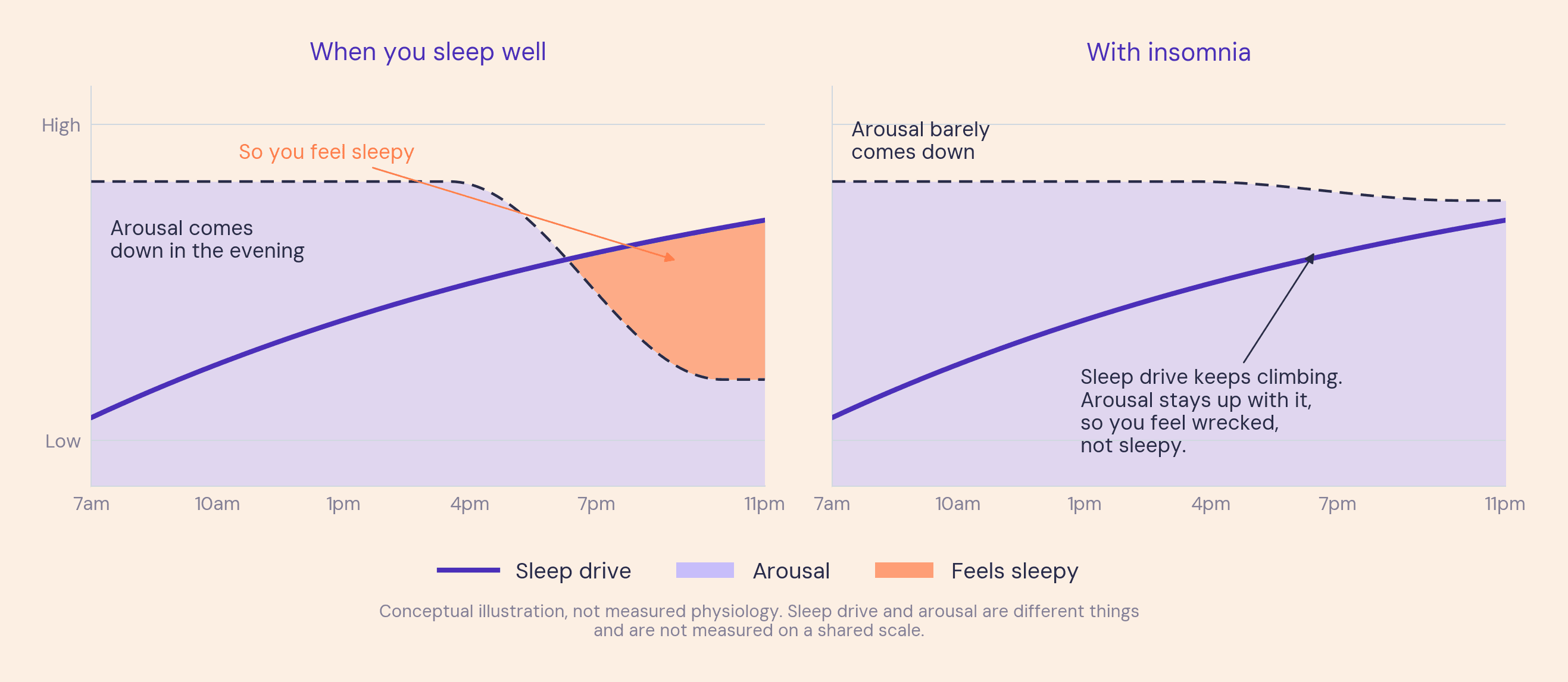
Feeling sleepy is not only a matter of how much sleep you are owed. It also depends on how switched on you are.
Compared with people who sleep well, people with insomnia sit at a higher level of activation, and not only at bedtime. It runs higher during the day too [2]. That is the part almost nobody gets told, and it is what makes the double state possible: desperate for sleep and unable to take it.
Recent work has narrowed down what being wired actually means. The clearest signs are in the brain, activity where you would expect quiet, and in a mind that will not stop turning the day over. The thing everyone blames, a racing heartbeat, is the piece the evidence has not pinned down [3].
Winding down in the evening is that activation coming down. The leading explanation for insomnia is that, for some people, it does not.
Exhausted every night and still wide awake?
Rest is a program built on the principles of CBT-I. Short daily coaching, by text or voice, that rebuilds sleep drive instead of fighting the clock.
The Sleepiness You Give Away During the Day
There is a second thing happening, and this one you have more control over.
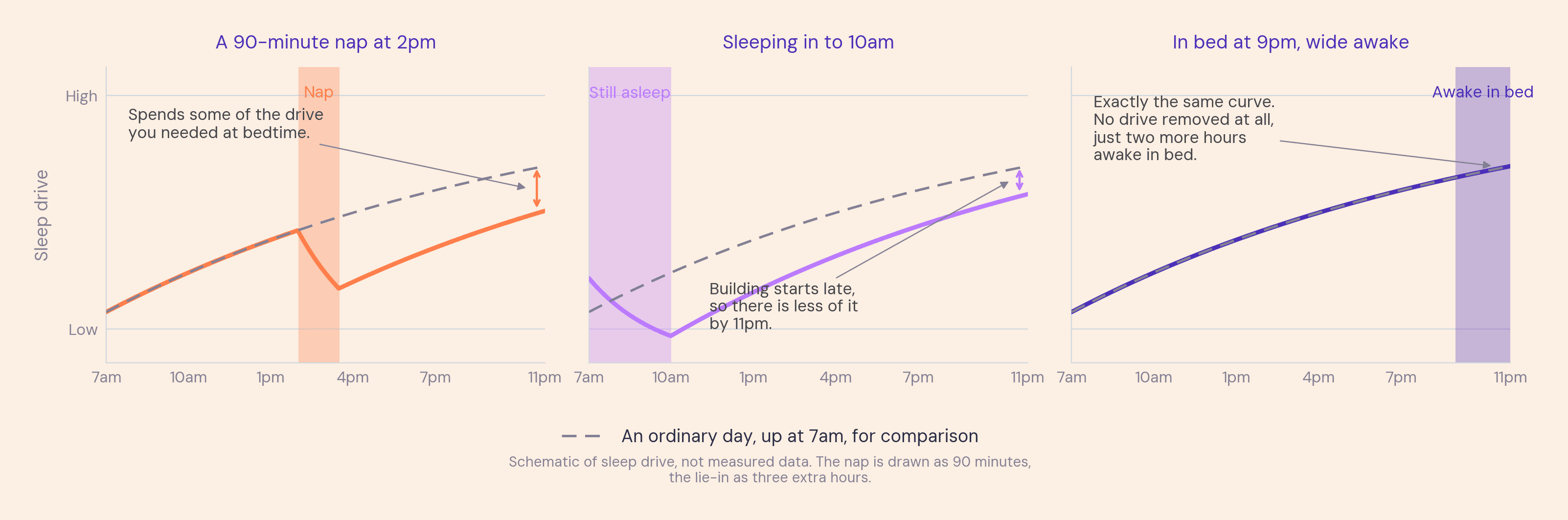
The pressure to sleep builds the longer you have been awake, and it is spent while you sleep [4]. So after a terrible night you should be carrying more of it, not less. Which raises the question of where it goes.
Mostly into the three moves people make to get through a bad day. A long afternoon nap spends a chunk of it, which is why naps can make insomnia worse even though they feel like the obvious fix. A weekend lie-in delays the whole build, so there is less of it by eleven. And going to bed at nine because you are shattered does something different again: unless you actually fall asleep, it removes no pressure at all. It just buys you two more hours awake in bed.
Why the Bed Makes It Worse
Those extra hours are not neutral. If you have ever nodded off on the couch and then found yourself wide awake the moment you got into bed, you have felt what comes next.
After enough nights of lying there trying, the bed stops being the place where you sleep and becomes the place where you fail to. It is a learned association and it forms quietly [5]. It is why lying awake in bed feels worse the longer you stay put. The couch is easier partly because it carries none of that history.
What to Do Instead
Stop trying to manufacture sleepiness and start protecting the sleepiness you already have.
Get up at the same time every morning, weekends included, so the pressure builds on a schedule your body can rely on. Skip the long afternoon naps. Go to bed when you are sleepy rather than when you are tired, which is usually later than you would like. And when you are in bed, clearly awake and getting annoyed, get up: keep the lights low, do something dull, and go back only when your eyes start going heavy [5].
The first week of that is uncomfortable. It is also the part that works.
Being exhausted and unable to sleep does not mean your body has forgotten how. The pressure is usually still there. What is missing is a clear run at it, and rebuilding that is what Cognitive Behavioral Therapy for Insomnia (CBT-I) does, the treatment sleep medicine puts first in line for chronic insomnia [6].
One thing worth ruling out. If you snore heavily, gasp in your sleep, cannot keep your eyes open during the day, or your legs will not settle at night, see a doctor. Other conditions can contribute to insomnia and often travel with it.
Full guide: How to Fall Asleep Fast: What Actually Works.
Exhausted and still wide awake? See how Rest can help »
Citations
Shen, J., Barbera, J., & Shapiro, C. M. (2006). Distinguishing sleepiness and fatigue: Focus on definition and measurement. Sleep Medicine Reviews, 10(1), 63–76. https://doi.org/10.1016/j.smrv.2005.05.004 — Sleepiness and fatigue are interrelated but distinct phenomena, "often used interchangeably, or merged under the more general lay term of 'tired'"; sleepiness is distinguished from fatigue by a presumed impairment of the normal arousal mechanism.
Riemann, D., Spiegelhalder, K., Feige, B., Voderholzer, U., Berger, T., Perlis, M., & Nissen, C. (2010). The hyperarousal model of insomnia: A review of the concept and its evidence. Sleep Medicine Reviews, 14(1), 19–31. https://doi.org/10.1016/j.smrv.2009.04.002 — Autonomic, neuroendocrine, neuroimmunological, electrophysiological and neuroimaging studies demonstrate increased levels of arousal in primary insomnia during both night and daytime; insomnia framed as a final common pathway of genetic vulnerability, stressors, and perpetuating behavioral and cognitive factors. Findings are group comparisons against good sleepers.
Dressle, R. J., & Riemann, D. (2023). Hyperarousal in insomnia disorder: Current evidence and potential mechanisms. Journal of Sleep Research, 32(6), e13928. https://doi.org/10.1111/jsr.13928 — Theoretical review describing hyperarousal as a state of relatively increased arousal: no conclusive evidence for autonomic variables such as heart rate and heart rate variability, while current literature supports central involvement of cortical arousal (high-frequency EEG activity) and cognitive-emotional hyperarousal in the form of insomnia-related thoughts and worries. Notes that most hyperarousal studies are cross-sectional comparisons between patients with insomnia and good sleeper controls.
Borbély, A. A., Daan, S., Wirz-Justice, A., & Deboer, T. (2016). The two-process model of sleep regulation: A reappraisal. Journal of Sleep Research, 25(2), 131–143. https://doi.org/10.1111/jsr.12371 — Sleep drive (Process S) builds during wake and is discharged during sleep.
Perlis, M. L., Smith, M. T., Benson-Jungquist, C., & Posner, D. A. (2005). Cognitive Behavioral Treatment of Insomnia: A Session-by-Session Guide. New York: Springer. https://doi.org/10.1007/0-387-29180-6 — Conditioned arousal and stimulus control; the bed as a learned cue for wakefulness; get out of bed once clearly awake and return only when sleepy.
Edinger, J. D., Arnedt, J. T., Bertisch, S. M., et al. (2021). Behavioral and psychological treatments for chronic insomnia disorder in adults: an American Academy of Sleep Medicine clinical practice guideline. Journal of Clinical Sleep Medicine, 17(2), 255–262. https://doi.org/10.5664/jcsm.8986 — Strong recommendation for multicomponent CBT-I in adults with chronic insomnia; conditional recommendations for stimulus control, sleep restriction therapy, and relaxation therapy as single-component options; suggests clinicians not use sleep hygiene as a single-component therapy.