

Scientifically Reviewed by
Dr. Elaine Blank, PhD
PhD in clinical psychology from the University of Arizona, Clinical internship at the University of Maryland,
Postdoctoral work at the Stanford University School of Medicine
The strip is on the nightstand because a video said nasal breathing is the upgrade, and tape is how you force it. Deeper sleep. Less snoring. A better jaw. You are supposed to stick it on, shut your mouth, and let the night take care of itself.
Part of the appeal is that it asks nothing of you. No new routine, no hour to protect, no discipline to hold at eleven at night when you are already tired of trying. Just a strip that does its work while you are unconscious. Then you wake at three anyway, tape still on, and lie there doing the arithmetic on how much of the night is left.
Does mouth taping help you sleep? There is no good evidence that it treats insomnia. Not that tape was tested and failed, but that nobody has tested it on people whose problem is lying awake. The research that exists looked at selected mouth-breathers with snoring or sleep-disordered breathing. A 2025 review of 10 small and very mixed studies found only two reporting a significant improvement in established sleep-apnea markers, inconsistent results elsewhere, and nothing that supports general use [1]. It also flagged what the videos skip: blocking the mouth can impede breathing when nasal airflow is limited. In a 2023 press release, a spokesperson for the American Academy of Sleep Medicine (AASM) called mouth taping potentially "extremely dangerous"; the same release reported an online survey in which 12% of 2,005 U.S. adults said they had tried it [2].
What Is Mouth Taping?
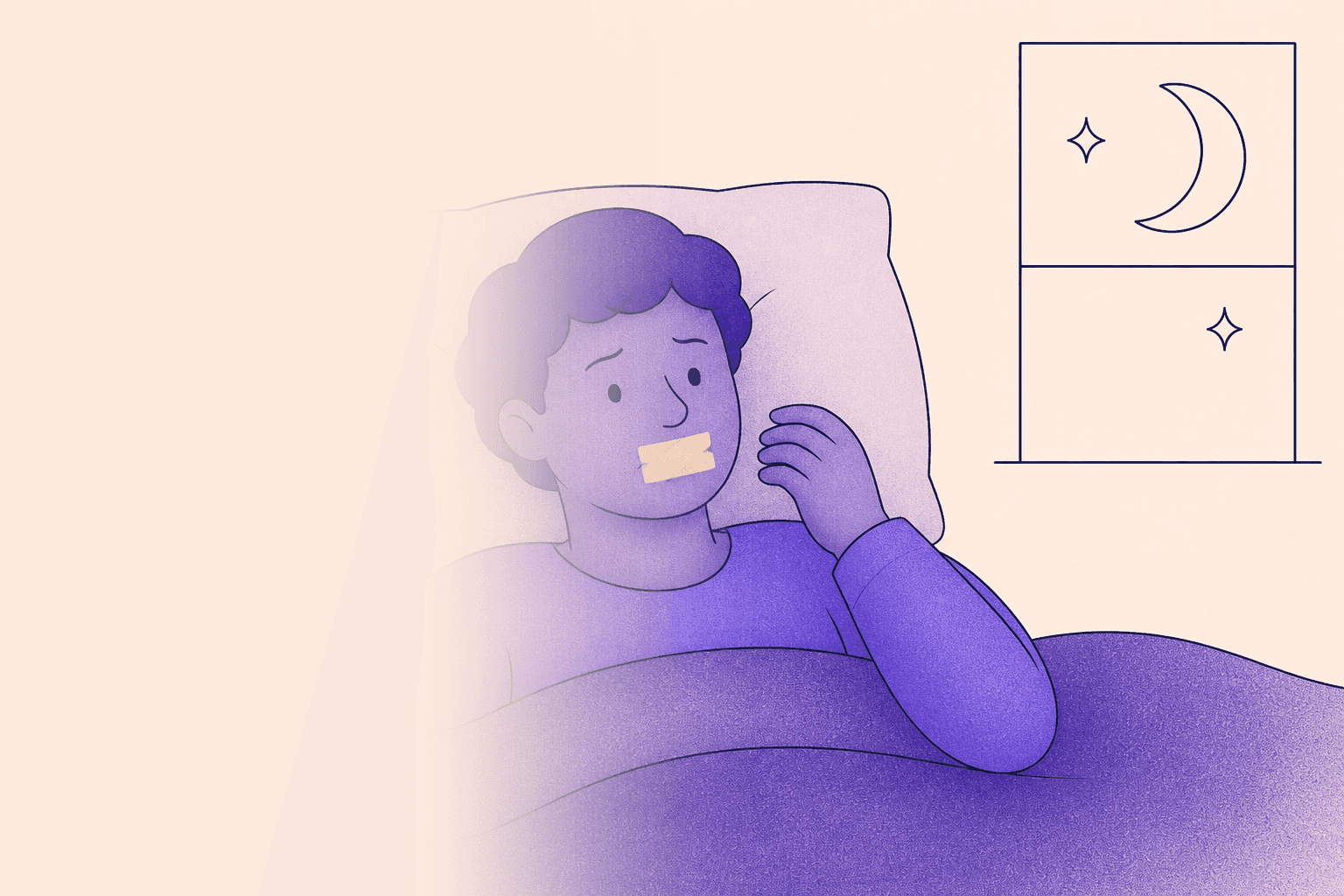
Mouth taping is placing a strip of tape across the lips so you have to breathe through your nose all night. It spread on TikTok as a sleep hack, sometimes under the looser name sleepmaxxing, and it got a second life from breathing books and jawline videos. The claim is simple: the nose filters, humidifies, and keeps the airway more stable, so sealing the mouth should mean better sleep.
Nasal breathing itself is the ordinary route. The leap is the tape. Forcing a switch overnight is not the same as having a clear nose, and it is not a test of whether your insomnia is a breathing problem.
In 2025, Rest counted more than 1,000 recommendations in a viral sleep thread. Mouth tape came up 52 times, ahead of melatonin. Cognitive Behavioral Therapy for Insomnia (CBT-I), the approach sleep medicine puts first for chronic insomnia, came up three times [3][4]. The feed and the clinic are not having the same conversation.
Does Mouth Taping Help Snoring or Sleep Apnea?
The study the trend leans on is a 2022 retrospective study from a hospital sleep clinic in Taiwan: 20 adults with mild obstructive sleep apnea who were already known mouth-breathers, 19 of them men. They did one home sleep test at baseline and a second one a week later with their mouths taped. Between those two nights the median count of breathing pauses fell from 8.3 an hour to 4.7, and the snoring index fell by about half [5]. That is one taped night measured against one untaped night, not a week of taping and not a course of treatment.
In the study, all the subjects had mild disease and a body-mass index under 30, and anyone with nasal obstruction was given medication or a nasal spray first, to make the taping workable. People who could not keep the tape on until morning were excluded. People with insomnia were sent for full polysomnography instead of this protocol [5]. There was no sham tape and no comparison group. The authors list the small sample, the missing control, the retrospective design and the short follow-up as limitations themselves [5]. They suggested tape as a step before continuous positive airway pressure (CPAP) or surgery. That is their conclusion, not a guideline, and it is not evidence about insomnia.
The 2025 review put that paper next to nine others, about 200 people in total. It pools tape with porous oral patches, sealing and chin straps, some of them used alongside a mandibular device or a nasal spray. Two of the ten reported a significant improvement in established apnea markers. Results for snoring and the other measures were inconsistent, and every one of the ten was rated poor quality on the Newcastle-Ottawa scale. The reviewers concluded that indiscriminate use carries a potentially serious risk of harm and that clinical benefit remains unproven [1].
Snoring and gasping can be signs of obstructive sleep apnea, which is a medical condition. Tape is not an evaluation, and it is not an established treatment for it. If those symptoms sound familiar, that is a reason to see a clinician.
Still taping your mouth for insomnia?
Rest is a program built on the principles of CBT-I. A short conversation each morning, by text or voice, for the nights tape was never going to settle.
Is Mouth Taping Safe?
In a 2023 AASM press release, spokesperson Dr. John Saito described mouth taping as potentially "extremely dangerous" [2]. Mouth breathing is often the backup route, because the nose is congested, the septum is off, or the airway is collapsing. Tape removes the backup.
The studies are far too small and too selective to establish a rate of serious harm, and none reports one. Four of the ten explicitly warned about asphyxiation where there is nasal obstruction or regurgitation [1], and four either excluded people with nasal obstruction or treated it before taping [1][5]. The research that makes tape look reasonable largely removed the people most likely to be harmed by it. Skin irritation and a tape allergy are the small problems. The large one is not being able to breathe.
A 2024 trial measured airflow in 54 people with sleep apnea while their mouths were held shut. In the twelve who mouth-breathed the most it got worse, falling by about 1.9 liters a minute [6]. For some people the mouth appears to be an important alternative airway. That was under sedation, with a hand on the chin rather than tape, so it describes a mechanism rather than a verdict.
No study in the review offers evidence about children; the average ages run from 38 to 64 [1]. Persistent snoring or suspected apnea in a child needs a pediatric or sleep-specialist evaluation. For a blocked nose, what helps depends on the cause, and a clinician might suggest saline, allergy treatment or a nasal dilator.
Does Mouth Taping Help Insomnia?
Mouth breathing is not an established cause of chronic insomnia, or a target for treating it. That is not the same as saying the two never appear together, and insomnia and sleep-disordered breathing coexist often enough to have their own literature. But insomnia runs on a different pattern: the body stays a little too activated, around the clock, and the bed itself becomes a cue for being awake [7][8]. That is why lying awake in bed feels worse the longer you stay there.
There is a reasonable case that tape feeds that loop, though nobody has tested it. You would be trying to sleep and trying to keep your mouth shut at the same time. Effort raises arousal, arousal keeps you awake, and an uncomfortable strip on your face is one more thing to notice at three in the morning. That is an inference from how insomnia works [7][8], not a finding about tape.
The useful question is not whether nasal breathing is healthier. It usually is. The question is whether forcing it with tape reaches whatever has kept you awake for months, and nothing in the research says it does.
What Helps Insomnia More Than Mouth Taping
Here is where the trend comes closest to being onto something. Breathing does appear in insomnia treatment, just not as hardware. The AASM guideline includes relaxation therapy among its recommended single-component treatments for chronic insomnia, and defines it as structured exercises for lowering bodily tension and mental arousal: abdominal breathing, progressive muscle relaxation, guided imagery. That recommendation is conditional, drawn from five trials the task force graded as low quality [4]. A real tool, honestly labeled, and a modest one.
Notice what it is aimed at. It is practiced awake, on purpose, to bring arousal down, which is the thing keeping the insomnia running [7][8]. Tape does close to the reverse. It takes a route the body was already managing and pins it shut while you are unconscious, and it leaves arousal exactly where it was.
The stronger recommendation in that same guideline is for full CBT-I, and the American College of Physicians puts it first, ahead of medication [4][9]. Its behavioral core is a fixed wake time, matching time in bed to the sleep you are actually getting, and leaving the bed once you are fully awake and annoyed rather than staying to try harder. That is what Rest coaches, in a short daily conversation by text or by voice. The program is built on those behavioral principles, together with world-class sleep experts from institutions like UCSF and Stanford.
If you snore, gasp, or wake exhausted after a full night in bed, that is a conversation with a clinician, not a reason to start with tape.
The Questions People Keep Asking
Does mouth taping help you sleep? There is no good evidence that mouth taping treats insomnia, and it has not been properly studied as an insomnia treatment. The small studies that exist looked at selected people with mouth breathing or sleep-disordered breathing, not at people whose nights have been off for months [1][5]. There is little reason to believe that taping helps insomnia specifically, and a few reasons to think it could make it worse.
Is mouth taping safe? Blocking the mouth can impede breathing when nasal airflow is limited, which matters if your nose is congested or you have undiagnosed sleep apnea. An AASM spokesperson has called the trend potentially "extremely dangerous" [2], and four of the ten studies in the 2025 review explicitly warned about possible asphyxiation with nasal obstruction or regurgitation [1]. How often serious harm actually occurs is unknown, because the studies are too small and too selective to say. The evidence covers adults, not children.
Does mouth taping help sleep apnea? One small retrospective study in 20 mouth-breathers with mild obstructive sleep apnea recorded fewer breathing pauses and less snoring on a single taped night [5]. A later review of 10 mixed studies found that signal in only two of them, alongside a potentially serious risk of harm from indiscriminate use [1]. It is not an established treatment, and not a substitute for an evaluation or for proven apnea therapy.
Does mouth taping stop snoring? The snoring index fell by about half in that same selected group, on that one taped night [5]. Whether that transfers to snorers in general is unproven, and snoring can be a sign of sleep apnea, which tape does not diagnose.
Can mouth taping make insomnia worse? It has not been tested in insomnia trials, so there is no direct answer. It could plausibly worsen sleep for some people through discomfort, anxiety, or the extra effort of managing something on your face at night, which is the kind of effort that raises the alertness insomnia runs on [7][8].
Why Insomnia Has No Quick Fix
The appeal of tape is that it is a fix you apply and forget. Stick it on, and the night is supposed to handle itself. That is what makes it filmable, and it is why the trend will likely continue.
Insomnia does not give way to that kind of fix. What keeps it going is rarely an open mouth. It is the hours of effort, the extra time in bed, the bed that has come to mean trying. Undoing that means changing when you get up, how long you stay in bed, and what you do at three in the morning. Those changes are uncomfortable before they are easy, which is why the treatment with the best evidence behind it is a structured program rather than a product.
That is the work Rest is built to carry. It sets the schedule, adjusts it as your sleep changes, and keeps you to it through a short conversation each morning, by text or by voice, which is the part that is hardest to do alone. It asks more of you than a strip of tape. It is also aimed at the thing actually keeping you awake. Start with Rest »
Disclaimer. Mouth taping has not been established as a safe or effective treatment for insomnia and may impede breathing in some people. Seek medical advice before trying it, particularly if you snore, gasp, have nasal obstruction, or may have sleep apnea. This article is published for general information only. It is not medical advice or a diagnosis, and nothing here is a recommendation to take, avoid, or change any supplement or medication. Rest is not a substitute for professional medical care. Do not start, stop, or adjust a treatment, including a prescribed sleep medication, without talking to your clinician.
Citations
Rhee, J., Iansavitchene, A., Mannala, S., Graham, M. E., & Rotenberg, B. (2025). Breaking social media fads and uncovering the safety and efficacy of mouth taping in patients with mouth breathing, sleep disordered breathing, or obstructive sleep apnea: A systematic review. PLoS One, 20(5), e0323643. https://doi.org/10.1371/journal.pone.0323643 — 10 studies of oral occlusion (tape, porous oral patches, sealing, chin straps; some combined with a mandibular advancement device or nasal spray), so not 10 clean trials of tape.
American Academy of Sleep Medicine. (2023, July 25). Viral TikTok trends are not the answer for better sleep. https://aasm.org/viral-tiktok-trends-are-not-the-answer-for-better-sleep/ — Online survey of 2,005 U.S. adults, March 24–29, 2023, margin of error ±2 percentage points; 12% had tried mouth taping, which AASM spokesperson Dr. John Saito called "extremely dangerous."
Rest. (2025, October 30). We analyzed 1,000+ sleep recommendations from a viral thread. https://getrest.app/blog/sleep-recommendations-x-thread — Rest's own count; mouth tape 52 mentions, melatonin 28, CBT-I 3. Not a nationally representative sample.
Edinger, J. D., Arnedt, J. T., Bertisch, S. M., et al. (2021). Behavioral and psychological treatments for chronic insomnia disorder in adults: An American Academy of Sleep Medicine clinical practice guideline. Journal of Clinical Sleep Medicine, 17(2), 255–262. https://doi.org/10.5664/jcsm.8986 — Recommendation 1: strong recommendation for multicomponent CBT-I in adults. Recommendation 5: conditional recommendation for relaxation therapy as a single-component therapy, defined as structured exercises reducing somatic tension (abdominal breathing, progressive muscle relaxation, autogenic training) and cognitive arousal (guided imagery, meditation), based on 5 RCTs graded low quality.
Lee, Y.-C., Lu, C.-T., Cheng, W.-N., & Li, H.-Y. (2022). The impact of mouth-taping in mouth-breathers with mild obstructive sleep apnea: A preliminary study. Healthcare, 10(9), 1755. https://doi.org/10.3390/healthcare10091755 — Retrospective, Chang Gung Memorial Hospital, Taiwan, 2020–2021. n=20 (19 men), median age 38, median BMI 24.5 (inclusion required BMI<30, ages 20–60, AHI<15), witnessed mouth-breathing.
Yang, H., Huyett, P., Wang, T.-Y., Sumner, J., Azarbarzin, A., Labarca, G. P. T., et al. (2024). Mouth closure and airflow in patients with obstructive sleep apnea: A nonrandomized clinical trial. JAMA Otolaryngology–Head & Neck Surgery, 150(11), 1012–1019. https://doi.org/10.1001/jamaoto.2024.3319 — n=54 with OSA under drug-induced sleep endoscopy, mouth closed by pressure on the chin on alternating breaths; total inspiratory flow +1.0 L/min overall, but no association in the 10 near-zero mouth-breathers, +2.0 L/min in 32 moderate mouth-breathers, and −1.9 L/min (worse) in the 12 highest mouth-breathers; velopharyngeal obstruction associated with reduced airflow on closure.
Morin, C. M., & Espie, C. A. (2003). Insomnia: A Clinical Guide to Assessment and Treatment. New York: Kluwer Academic/Plenum Publishers. — Hyperarousal as a core mechanism in insomnia.
Perlis, M. L., Smith, M. T., Benson-Jungquist, C., & Posner, D. A. (2005). Cognitive Behavioral Treatment of Insomnia: A Session-by-Session Guide. New York: Springer. https://doi.org/10.1007/0-387-29180-6 — Stimulus control and conditioned arousal; bed used for sleep and sex only.
Qaseem, A., Kansagara, D., Forciea, M. A., Cooke, M., & Denberg, T. D. (2016). Management of chronic insomnia disorder in adults: A clinical practice guideline from the American College of Physicians. Annals of Internal Medicine, 165(2), 125–133. https://doi.org/10.7326/M15-2175 — CBT-I as the initial treatment for chronic insomnia in adults; consider medication if CBT-I alone is unsuccessful.